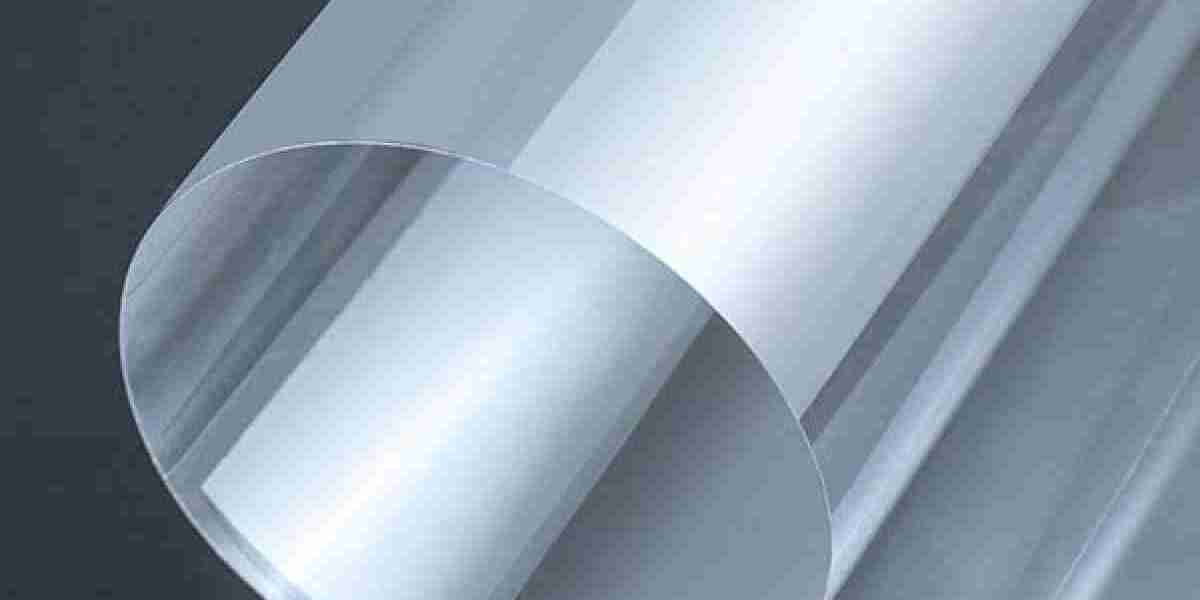

PETG has gradually earned recognition across multiple industrial sectors as a practical and adaptable thermoplastic, and PETG Film is increasingly discussed among manufacturers seeking a balance between performance reliability and processing efficiency. Unlike materials that prioritize a single advantage, this polyester-based film is valued because it integrates clarity, toughness, and chemical stability in ways that align well with modern production demands. Its growing presence is not the result of short-term trends, but of long-term suitability for applications that require consistent quality and visual precision.
From a material science perspective, this polyester-based sheet exhibits a stable amorphous structure that contributes to its transparency and dimensional consistency. The absence of crystalline regions allows light to pass through with minimal distortion, which is critical in applications where appearance and optical performance must be preserved after forming or cutting. At the same time, the polymer backbone provides impact resistance that exceeds many conventional transparent plastics, reducing the likelihood of cracking during fabrication or end use. These inherent properties make it especially useful in environments where both visual quality and mechanical resilience are expected.
Processing behavior is another reason this material has gained traction. During extrusion, temperature control plays a crucial role in maintaining uniform thickness and surface smoothness. The material responds well to controlled heating, softening evenly without sudden viscosity changes, which helps operators avoid defects such as bubbles or surface haze. In thermoforming processes, it demonstrates predictable forming behavior, allowing complex geometries to be achieved without excessive thinning at corners or edges. This reliability simplifies tooling design and reduces trial-and-error adjustments on the production line.
Cutting, die processing, and secondary fabrication are also relatively efficient. The film can be trimmed, punched, or CNC-cut with clean edges, minimizing post-processing requirements. Adhesion compatibility further expands its usability, as it bonds well with various inks, coatings, and laminates when proper surface treatment is applied. These characteristics collectively contribute to lower scrap rates and more stable output, factors that manufacturers closely monitor when evaluating material selection.
In terms of application, this transparent polyester sheet is widely adopted in packaging, where both protection and presentation matter. It is often chosen for folding cartons, display windows, and protective covers because it maintains clarity while offering sufficient rigidity. In electronics and consumer goods, it serves as a protective layer that shields components without obscuring branding or product details. The material is also applied in printing substrates, signage overlays, and interior decorative elements, where surface quality and color fidelity are essential.
Performance testing plays an important role in validating its suitability across these uses. Impact resistance tests help assess durability under sudden force, while tensile and elongation evaluations provide insight into flexibility and strength balance. Optical testing measures haze and light transmission to ensure visual consistency across batches. Chemical resistance tests are often conducted to confirm stability when exposed to cleaning agents, oils, or mild solvents, particularly for applications in public or commercial environments. These testing procedures help manufacturers align product specifications with real-world demands rather than theoretical benchmarks.
Environmental and regulatory considerations also influence material choice. This polyester-based film does not rely on plasticizers, which supports better long-term stability and reduces concerns related to migration. Its recyclability aligns with evolving sustainability expectations, especially in markets where material recovery and responsible sourcing are becoming standard evaluation criteria. While no material is without environmental impact, its durability and extended service life contribute to reduced replacement frequency, indirectly supporting waste reduction goals.
Shanghai MSD has observed these material trends through close collaboration with downstream users and international partners. By focusing on stable supply, consistent quality control, and practical application knowledge, the company supports customers who require dependable materials rather than experimental solutions. Understanding how processing conditions, performance requirements, and end-use expectations intersect allows suppliers to deliver value beyond basic material specifications.
As industries continue to refine their standards for transparency, durability, and manufacturability, this polyester-based solution remains a relevant choice for a wide range of applications. Companies seeking reliable material support and detailed application insight can explore more information and industry perspectives through Shanghai MSD at https://www.shanghaimsd.coml .