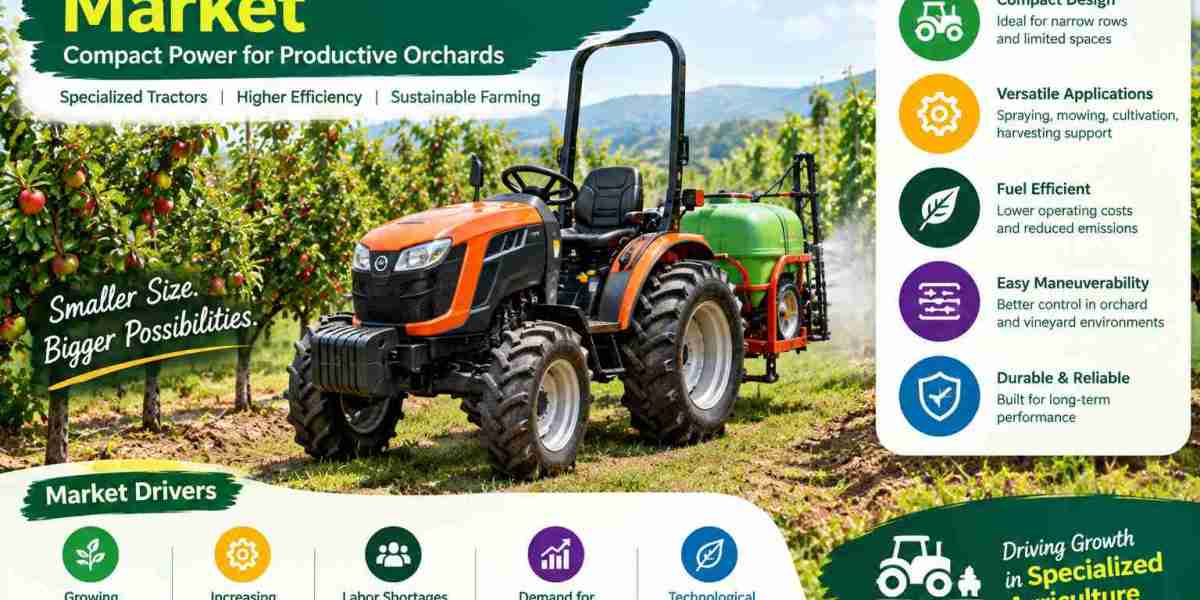

The Orchard Type Tractor Market reflects the changing requirements of modern fruit cultivation. Orchard farming involves a combination of activities that must be performed carefully around trees, crops, irrigation areas, and cultivated soil. Unlike large open agricultural fields, orchards can contain restricted pathways and closely spaced planting arrangements. This creates demand for agricultural machinery that can work efficiently within specialized environments. Orchard-type tractors are designed to support these requirements while helping farmers manage routine cultivation and maintenance activities.
The increasing focus on orchard machinery solutions highlights the importance of equipment specifically developed for fruit-growing operations. Such machinery can support several stages of agricultural work, including soil preparation, mowing, spraying, transportation, and vegetation management. Rather than relying entirely on general-purpose equipment, orchard managers can select tractors and implements according to the characteristics of their cultivated areas. This approach can help improve operational flexibility while addressing the practical challenges associated with orchard farming.
One of the key characteristics of orchard operations is the need for maneuverability. Trees are frequently arranged in rows, creating defined working corridors for agricultural machinery. The tractor must move through these spaces while allowing operators to perform necessary tasks without unnecessarily disturbing plants. A suitable orchard tractor can therefore become an important component of organized orchard management.
The physical design of agricultural equipment also matters. Orchard environments may contain branches at different heights and vegetation extending into tractor pathways. Machinery intended for such applications is developed with the working environment in mind. Farmers can consider factors such as tractor dimensions, operator visibility, handling characteristics, and compatibility with agricultural implements when selecting equipment.
Another important consideration is the ability to use implements for multiple farming activities. A tractor may serve as the main power unit for several attachments. Depending on farm requirements, implements can support mowing, soil work, spraying, cultivation, and transportation. This adaptability can make orchard tractors valuable throughout different periods of the farming cycle.
Orchard tractors can also support vegetation management. Maintaining the area between tree rows is an important part of orchard maintenance because unwanted vegetation can interfere with farming activities. Mowing and other vegetation-control practices can help maintain accessible pathways and organized cultivation areas. Tractor-based implements can provide a practical way to carry out these tasks across the orchard.
Transportation is another significant application. Fruit farms frequently need to move materials, tools, agricultural inputs, and harvested produce within the property. An orchard tractor can support these internal transportation activities when paired with appropriate equipment. This can help coordinate different stages of orchard operations and reduce reliance on manual movement across larger cultivated areas.
The role of operator comfort should not be overlooked. Agricultural tasks can require extended working periods, making practical controls and an appropriate operating environment important considerations. Machinery manufacturers continue to focus on improving the usability of agricultural equipment. Better control layouts, visibility, and operator-oriented features can make routine orchard work more manageable.
Digital technology is also creating new possibilities for farm equipment. Modern agricultural machinery can increasingly work alongside digital farm-management practices. Monitoring systems, equipment information, maintenance planning, and operational tracking can provide farmers with additional ways to organize machinery use. The integration of tractors with broader agricultural technology may become increasingly relevant as farms adopt more connected approaches.
Environmental considerations are another part of modern tractor selection. Orchard managers can look at machinery in relation to efficient farm practices, responsible resource use, and long-term soil and crop management. Proper equipment selection and maintenance can contribute to organized agricultural operations while supporting the overall productivity of an orchard.
As fruit farming continues to modernize, specialized agricultural machinery is likely to remain an important part of orchard management. Orchard-type tractors combine maneuverability, implement compatibility, and practical agricultural functionality. Their ability to work within specialized environments makes them relevant to growers seeking equipment suited to the unique requirements of fruit cultivation.
FAQs
1. What makes an orchard tractor different from a conventional tractor?
An orchard tractor is developed with fruit-growing environments in mind. Its design and operating characteristics are intended to support work around trees, narrow rows, branches, and other orchard-specific conditions.
2. What tasks can orchard tractors support?
They can support several activities, including mowing, cultivation, spraying, soil preparation, transportation, and general orchard maintenance.