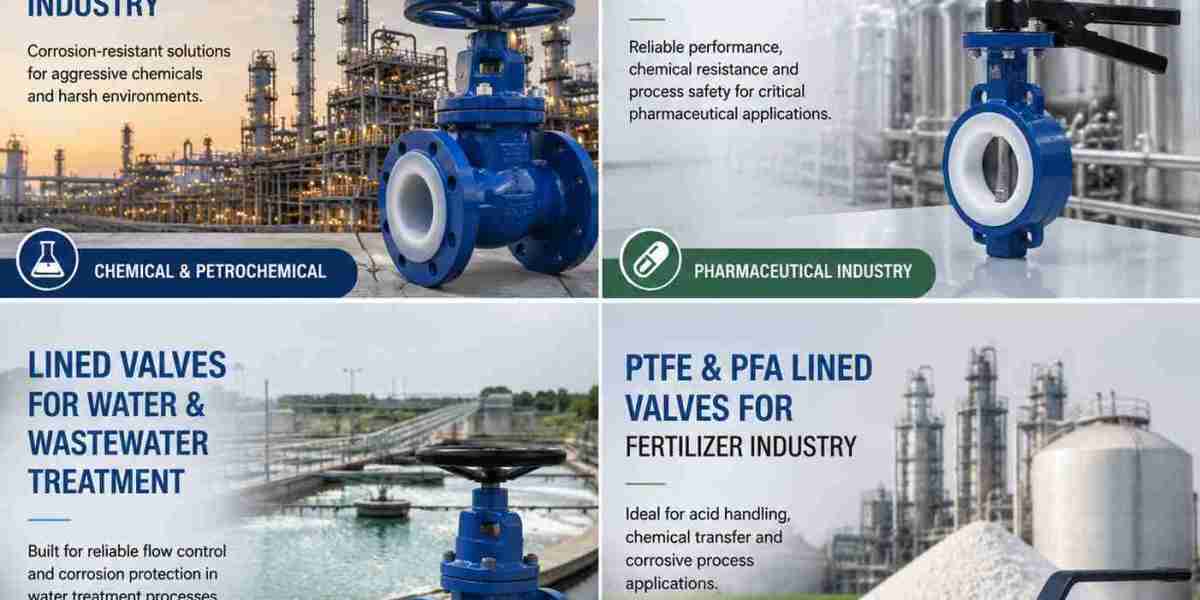

Fertilizer manufacturing involves the handling of acids, alkalis, chemicals and other aggressive process fluids. These materials can create challenging operating conditions for industrial valves and piping systems. Corrosion resistance, reliable isolation and appropriate material selection are therefore essential. PTFE and PFA lined valves can provide suitable solutions for selected fertilizer manufacturing applications.
Why Fertilizer Plants Use Lined Valves
Corrosive chemicals can attack metallic valve surfaces and contribute to leakage, corrosion and premature equipment failure. A lined valve uses a corrosion-resistant material on wetted surfaces to provide additional protection against the process media.
PTFE lined valves are widely considered for applications where resistance to aggressive chemicals is required. PTFE can provide excellent resistance to many acids, alkalis and solvents, making it suitable for various chemical-handling services.
The correct lining depends on the actual process conditions. PFA lined valves can be considered for demanding chemical applications where PFA's chemical resistance and operating characteristics are appropriate.
PTFE Valve Applications in Fertilizer Plants
A PTFE valve can be used for suitable chemical transfer and isolation applications throughout fertilizer manufacturing facilities. Depending on the system design, PTFE-lined ball, butterfly, gate, globe and check valves may be selected.
Typical applications include chemical dosing, acid handling, alkali handling, process fluid transfer and other corrosive services.
Teflon lined valves are another common term used when referring to PTFE-lined valves. However, engineers should always verify the specified lining material rather than selecting a valve based only on the term Teflon.
PFA and FEP Lined Valve Solutions
PFA can provide excellent chemical resistance for demanding applications where the process conditions require a specialized lining. PFA valves may therefore be considered for specific chemical services within fertilizer manufacturing.
FEP lined valves can also be suitable for selected applications where FEP provides the required chemical compatibility. The choice between PTFE, PFA and FEP should be based on chemical compatibility, temperature, pressure and other operating conditions.
Common Fertilizer Industry Applications
Lined valves can be considered for:
- Acid handling systems
- Chemical dosing
- Corrosive chemical transfer
- Process piping
- Chemical storage systems
- Neutralization systems
- Effluent treatment
- Aggressive media isolation
The required valve type depends on the process function. Ball valves are generally selected for isolation duties, while butterfly valves may be suitable for larger pipeline applications. Globe valves can be considered for specific flow-control services, and check valves help prevent reverse flow.
Benefits of Lined Valves
Using a correctly specified PTFE lined valve or PFA lined valve can provide:
- Improved resistance to chemical corrosion
- Protection of metallic valve surfaces
- Reliable shut-off
- Reduced maintenance caused by corrosion
- Long service potential
- Suitable solutions for aggressive process media
Choosing the Right Valve
Fertilizer plants handle different chemicals and operating conditions, so there is no single lining material suitable for every application. Engineers should evaluate the chemical composition and concentration of the fluid, operating temperature, pressure, valve size, flow conditions and required service life.
The lining material should be selected based on verified chemical compatibility. PTFE, PFA and FEP each have different characteristics, and selecting the correct material is essential for reliable performance.
Freture Techno Pvt. Ltd. provides PTFE, PFA and FEP lined valve solutions for industrial applications requiring corrosion resistance and dependable fluid isolation. With appropriate valve configuration and lining selection, fertilizer plants can improve process reliability and reduce corrosion-related maintenance.