
IMARC Group has recently released a new research study titled “Argentina Road Freight Transport Market Report by Temperature Control, Product Type, Distance, Containerization, Destination, End User, and Region, 2026-2034,” offers a detailed analysis of the market drivers, segmentation, growth opportunities, trends and competitive landscape to understand the current and future market scenarios.
Argentina Road Freight Transport Market Size, Growth, and Forecast (2026-2034)
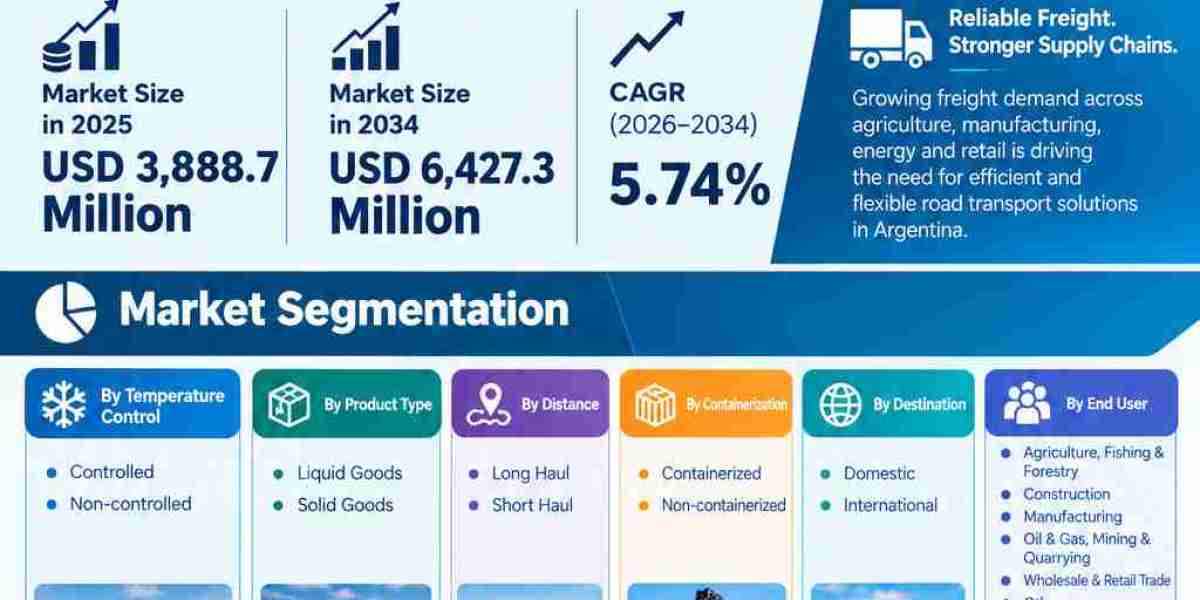
The argentina road freight transport market size reached USD 3,888.7 Million in 2025 and is projected to reach USD 6,427.3 Million by 2034, growing at a CAGR of 5.74% during 2026-2034. Increasing industrial production, growth in e-commerce, infrastructure improvements, rising demand for efficient and reliable delivery services, and government initiatives to enhance transportation networks are the primary factors driving the argentina road freight transport market.
Road freight transport refers to the movement of goods by truck over short and long distances, covering liquid and solid goods, temperature-controlled and non-controlled cargo, and containerized and non-containerized shipments. It is the backbone of domestic and cross-border trade, linking farms, mines, factories, ports, and retailers across the country.
Argentina’s large territory and the long distances between production centers, ports, and consumers make trucking the dominant way to move goods. As agriculture, energy, mining, manufacturing, and online retail all depend on dependable trucking services, businesses are placing greater importance on efficient fleets, better roads, and tighter logistics networks.
Explore Growth Opportunities in the Argentina Road Freight Transport Market - Grab Your Sample Report for Evaluation: https://www.imarcgroup.com/argentina-road-freight-transport-market/requestsample
Key Trends Driving the Argentina Road Freight Transport Market
• Growth in e-commerce: The rapid expansion of online retail is raising demand for efficient and timely delivery services, significantly driving the road freight market. According to the International Trade Administration, e-commerce activity has grown tenfold since 2000 in peso terms, and Argentina has over 37 million internet users, the third highest share in Latin America after Brazil and Mexico. The Argentine Chamber of Electronic Commerce reports that 95 percent of connected Argentine adults, about 19 million people, have made online purchases at least once.
• Increased industrial production: As industrial activity grows, so does the need to transport raw materials and finished goods by road. According to Trading Economics, industrial production in Argentina fell 16.6% year-on-year in April 2024, the eleventh consecutive month of contraction but a notable improvement from the 21.2% decline in March. Declines eased across basic metals, machinery and equipment, manufacturing, and food and beverages, pointing to a gradual recovery in freight volumes as output stabilizes.
• Infrastructure improvements and road concessions: Government initiatives to enhance transportation networks are reshaping the road corridors that carry most freight. Through the Red Federal de Concesiones, Argentina is transferring more than 9,000 kilometers of national routes to private operators under 20-year toll concessions, with the aim of rehabilitating roads, improving safety, and reducing logistics costs on corridors that carry about 80% of national traffic.
Argentina Road Freight Transport Market Report Segmentation:
The Argentina Road Freight Transport Market report provides a detailed segmentation analysis to help businesses identify key growth segments and evolving industry dynamics. The market is categorized based on temperature control, product type, distance, containerization, destination, and end user, offering comprehensive insights across the argentina road freight transport market.
Temperature Control Insights:
• Controlled: Temperature-controlled trucking carries perishable foods, pharmaceuticals, and other sensitive goods that need refrigerated or climate-managed transport.
• Non-controlled: Non-controlled freight covers general cargo, bulk materials, and manufactured goods that do not require temperature management.
Product Type Insights:
• Liquid Goods: Liquid goods, including fuels, chemicals, and beverages, move by tanker and specialized trucks.
• Solid Goods: Solid goods, such as grains, construction materials, minerals, and packaged products, account for a wide range of road freight movements.
Distance Insights:
• Long Haul: Long haul trucking links distant production regions with ports and major consumption centers, which is especially important given Argentina’s size.
• Short Haul: Short haul services support urban distribution, regional deliveries, and last-mile logistics, particularly for e-commerce.
Containerization Insights:
• Containerized: Containerized freight supports import and export flows and connects ports with inland logistics hubs.
• Non-containerized: Non-containerized freight covers bulk and loose cargo moved directly by truck, including agricultural and industrial goods.
Destination Insights:
• Domestic: Domestic freight serves internal trade between provinces, cities, and production centers.
• International: International freight supports cross-border trade, including road links with Brazil, Uruguay, and other Mercosur partners.
End User Insights:
• Agriculture, Fishing and Forestry: Agriculture, fishing and forestry depend heavily on trucking to move crops and products from rural areas to ports and processors.
• Construction: Construction activity creates demand for the transport of cement, steel, aggregates, and equipment.
• Manufacturing: Manufacturers rely on road freight for inputs, components, and finished goods.
• Oil and Gas, Mining and Quarrying: Energy and mining operations need heavy-duty trucking to reach remote sites, supporting demand for specialized fleets.
• Wholesale and Retail Trade: Wholesale and retail trade, including e-commerce, drives frequent and time-sensitive deliveries.
• Others: Other sectors add to steady demand across the broader economy.
Regional Insights:
• Buenos Aires Region: The Buenos Aires Region, anchored by the capital and its port and industrial belt, is the center of national freight activity.
• Litoral Region: The Litoral Region is closely tied to river ports and agricultural exports, generating heavy grain and agro-industrial truck flows.
• Northern Region: The Northern Region supports regional agriculture, industry, and cross-border trade.
• Cordoba Region: The Cordoba Region combines strong agricultural output with industrial and automotive activity at the center of the country.
• Cuyo Region: The Cuyo Region supports wine, agriculture, and growing mining activity, along with trade links toward Chile.
• Patagonia Region: The Patagonia Region relies on long-distance trucking for energy, mining, and regional supply.
Argentina Road Freight Transport Market: Recent News and Developments
• April 2026: Andreani announced an investment of USD 30 million to fully automate its Hub in General Pacheco, north of Greater Buenos Aires, adding artificial intelligence and advanced sorting that raise capacity to 26,000 packages per hour, while also renewing its fleet with 40 articulated bitrén trucks for heavy cargo to Patagonian oil fields and mining projects.
• August 2026: Argentina’s government announced the award of Stage III of the Red Federal de Concesiones, covering more than 3,900 kilometers of national routes in eight sections under 100% private investment, completing more than 9,000 kilometers of toll concessions across 16 strategic sections that carry about 80% of the country’s traffic.
Challenges Impacting the Argentina Road Freight Transport Market
Rising operating costs weigh on carriers and shippers. Industry reports showed cargo transport costs rising 2.42% in April 2026 and accumulating 17.8% over 2026 to that point, putting pressure on margins and on the prices that customers pay.
Uneven economic activity and the condition of road infrastructure add uncertainty to freight volumes and delivery times. While new road concessions should improve key corridors over time, the benefits will depend on the pace of works and on how toll costs affect transport operators.
Investment Opportunities in the Argentina Road Freight Transport Market
The argentina road freight transport market presents compelling investment opportunities supported by its projected growth from USD 3,888.7 Million in 2025 to USD 6,427.3 Million by 2034. Fleet renewal, specialized heavy transport for mining and energy, and temperature-controlled capacity for food and pharmaceutical shipments offer clear room for expansion.
Automated sorting hubs, real-time fleet monitoring, and technology platforms that connect shippers with carriers represent a growing investment frontier, particularly as e-commerce demand rises. Companies that combine modern fleets, digital tracking, and strong regional coverage can build strong competitive positions in this expanding market.
Outlook of the Argentina Road Freight Transport Market (2026-2034)
The outlook for the argentina road freight transport market is positive, supported by e-commerce growth, a gradual recovery in industrial output, and large-scale investment in road corridors. The market is projected to grow from USD 3,888.7 Million in 2025 to USD 6,427.3 Million by 2034 at a CAGR of 5.74%.
Road concessions and infrastructure upgrades, fleet modernization, and the digitization of logistics networks will be the defining trends shaping the argentina road freight transport market through 2034.
Key Players in the Argentina Road Freight Transport Market
The argentina road freight transport market is served by a mix of domestic logistics operators and global truck suppliers competing on the basis of network coverage, fleet quality, and service reliability.
• Andreani: Grupo Logístico Andreani is a leading Argentine logistics company that began in 1945 as a freight transport business in Casilda, Santa Fe. In April 2026, it announced a USD 30 million investment to automate its Pacheco hub, which is linked to its Tigre transfer center and a fleet of 300 to 400 heavy trucks, and it is expanding into mining and heavy cargo logistics.
• Scania Argentina: Scania Argentina supplies heavy trucks and related services to Argentine carriers, and its Tucumán plant, which began operating in 1976, exports its production to Scania’s global network. In September 2026, the company inaugurated an expanded service point in San Juan after a USD 2.3 million investment, strengthening support for long-distance, fuel, and mining transport in the Cuyo region.
Frequently Asked Questions (FAQs): Argentina Road Freight Transport Market
1. What is the current Argentina road freight transport market size?
The Argentina road freight transport market size reached USD 3,888.7 Million in 2025 and is projected to reach USD 6,427.3 Million by 2034, growing at a CAGR of 5.74% during 2026-2034.
2. What is road freight transport?
Road freight transport is the movement of goods by truck over short and long distances, covering liquid and solid products, temperature-controlled and non-controlled cargo, and domestic and international shipments.
3. What are the key drivers of the argentina road freight transport market?
Key drivers include increasing industrial production, growth in e-commerce, infrastructure improvements, rising demand for efficient and reliable delivery services, and government initiatives to enhance transportation networks.
4. How is the argentina road freight transport market segmented?
The market is segmented by temperature control (controlled and non-controlled), product type (liquid and solid goods), distance (long haul and short haul), containerization (containerized and non-containerized), destination (domestic and international), end user (agriculture, fishing and forestry, construction, manufacturing, oil and gas, mining and quarrying, wholesale and retail trade, and others), and region (Buenos Aires, Litoral, Northern, Cordoba, Cuyo, and Patagonia).
5. Who are the key players in the argentina road freight transport market?
Key players in the argentina road freight transport market include Andreani and Scania Argentina, alongside other logistics operators, carriers, and truck suppliers serving agriculture, industry, mining, and retail.
Author IMARC Group
IMARC Group is a global management consulting firm that helps the world's most ambitious changemakers to create a lasting impact. The company provide a comprehensive suite of market entry and expansion services. IMARC offerings include thorough market assessment, feasibility studies, company incorporation assistance, factory setup support, regulatory approvals and licensing navigation, branding, marketing and sales strategies, competitive landscape and benchmarking analyses, pricing and cost research, and procurement research.
Contact Us
IMARC Group,
134 N 4th St. Brooklyn, NY 11249, USA,
Email: sales@imarcgroup.com,
United States: +1-201971-6302