
That requirement creates thousands of repositioning movements across the industry, including flights where no paying passengers are booked.
For operators, repositioning is part of running an aircraft network. For travellers, it can occasionally create a different type of charter opportunity.
These flights are known as empty legs.
Because the aircraft is already scheduled to move, the operator may be able to sell the unused sector for substantially less than a newly arranged charter. Discounts of 50–75% are possible because the underlying aircraft movement exists independently of the new passenger.
The problem is that empty legs inherit the uncertainty of the schedule that created them.
They can appear with little notice, change as operating plans move and disappear as soon as the aircraft is booked or its next assignment changes.
Dubai-based RentJet has built a technology layer specifically around that behaviour. Empty Legs Radar combines continuously refreshed web inventory with automated route monitoring through Telegram.
Following moving inventory
A traditional charter request remains available as a process: ask for a route, receive aircraft options and arrange the flight.
Empty legs behave more like live inventory.
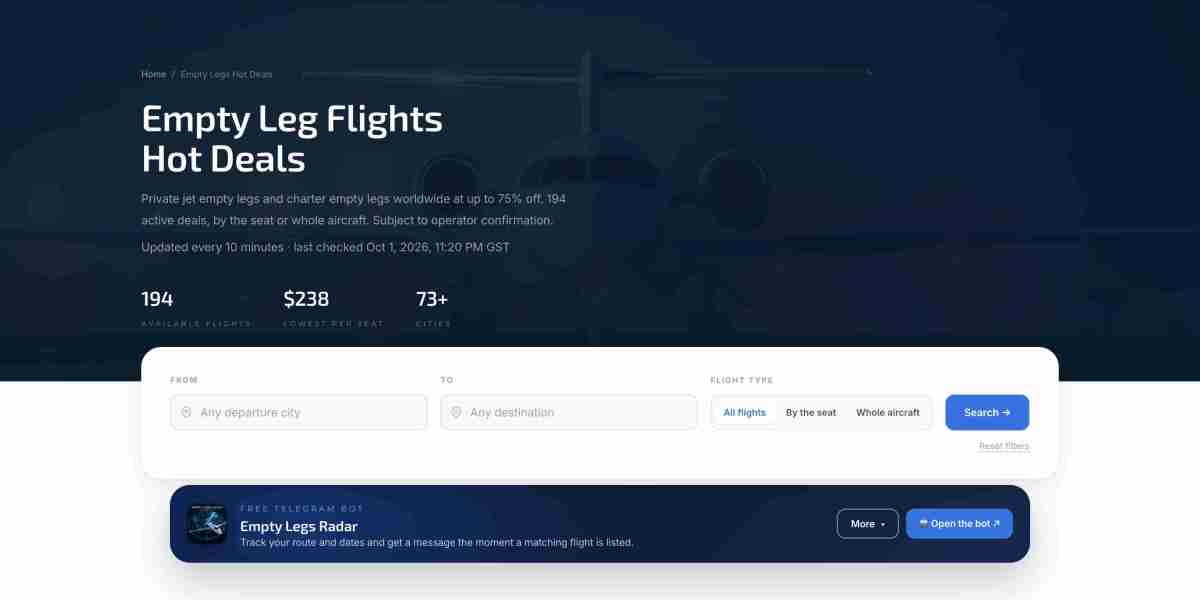
At any moment, RentJet says its system may contain around 200 active repositioning opportunities, based on figures current to September 28, 2026. The platform covers more than 140 departure cities and more than 420 routes.
Those opportunities are organised on the live empty leg flights section of the RentJet website.
The feed refreshes every ten minutes and includes two broad types of inventory: flights where seats are offered individually and opportunities where the customer books the aircraft as a whole.
Dedicated departure-city pages make it possible to browse what is leaving from a particular airport region, while route pages add recent pricing history for specific city pairs.
That historical layer is useful because empty leg prices can otherwise be difficult to interpret in isolation. There is no published timetable or permanent fare structure comparable to a commercial airline.
Turning a search into a standing instruction
The Telegram bot takes a different approach.
Instead of asking users to browse the same route repeatedly, @emptylegsradar_bot allows them to create a standing search.
The /track command is used to define a route and date range. Up to five searches can run simultaneously.
After that, the traveller does not have to keep checking the website every few hours. The system checks the changing inventory every ten minutes and sends a message if a flight matches the specified conditions.
The design is deliberately limited:
one flight produces one alert;
departure time is displayed in the airport's local time;
monitoring is free;
no RentJet account or separate registration is required.
The Telegram channel @emptylegsradar serves users who prefer to follow the broader feed rather than configure individual routes.
This division between a public channel and personalised route monitoring gives professional users two ways to interact with the same changing inventory.
The economics behind the discount
The 50–75% figure associated with empty legs can sound unusually large compared with discounts in most transport markets, but the economics are different.
A conventional private charter is organised because a customer needs the aircraft to fly a specific sector. Pricing must therefore account for positioning, crew, aircraft costs and the operational requirements associated with fulfilling that particular request.
An empty leg already exists as part of another movement.
Selling it does not mean operating a newly scheduled flight solely for the additional passenger. This creates room for a lower price.
On some light-jet opportunities, individual seats may begin at several hundred dollars. Whole-aircraft offers remain more expensive, but may still be materially below the cost of arranging the same journey as an ordinary charter.
There is a trade-off: the traveller gains the potential discount but loses the ability to freely define every element of the schedule.
That is why monitoring matters.
Software built inside the aviation business
RentJet developed Empty Legs Radar itself.
The system is not presented as a third-party tool embedded into the RentJet website. According to the company, the website infrastructure, data processing and Telegram monitoring were built in-house around its private aviation workflow.
RentJet itself is based in Dubai and works internationally through a network of partner operators. Those operators perform the flights, while RentJet organises the service and the technology used to discover and monitor suitable opportunities.
That operating structure also explains why data management is central to the project. A platform covering a large number of routes and partner-operated aircraft has to turn constantly changing availability into something a traveller can understand quickly.
A static page updated occasionally would solve only part of the problem.
A different way to distribute unused capacity
The broader idea behind the service is straightforward.
Private aviation already produces repositioning flights. Some of those aircraft have capacity that could be useful to another traveller, but only for a limited window and only on the route the aircraft already needs to fly.
The challenge is therefore less about creating new supply than connecting temporary supply with people who can use it.
RentJet's approach is to make that process continuous. The website provides live inventory and route context, while the bot keeps searching after the user closes the browser.
That does not make empty leg availability predictable.
It does make it easier to observe.
And in a market where a useful flight can appear and disappear within the same day, continuous observation is the part that software is particularly well suited to handle.