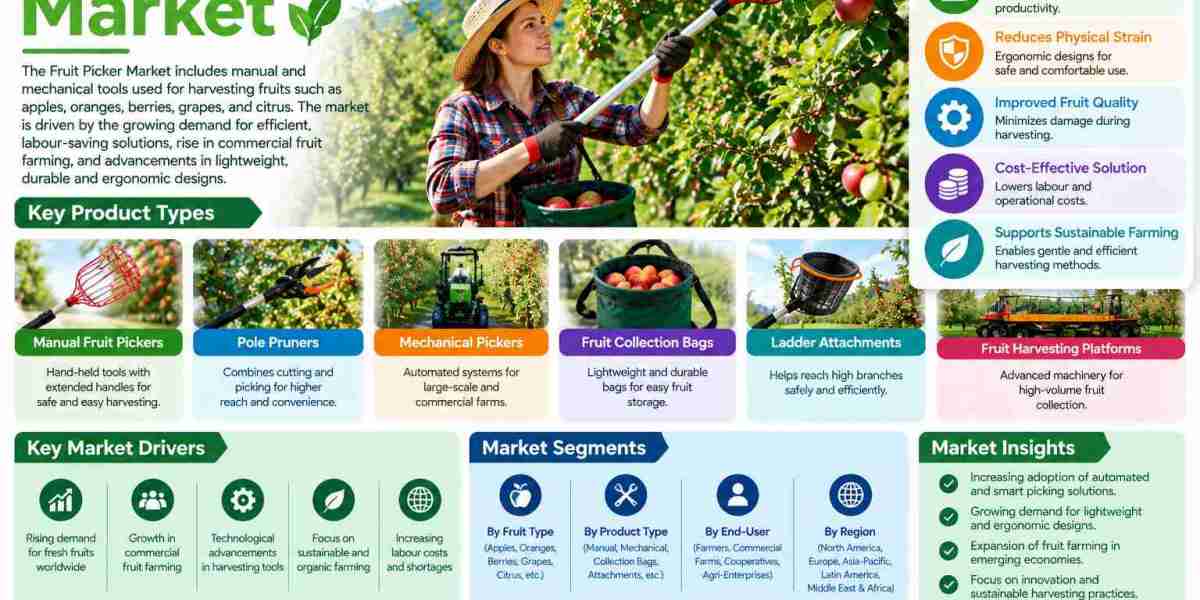

The Fruit Picker Market is developing as agricultural producers increasingly explore equipment that can support efficient harvesting and modern orchard management. Fruit harvesting requires careful coordination between workers, equipment, collection processes, and farm operations. Traditional manual methods remain important, but technological advancements are introducing additional options for growers seeking greater convenience and improved harvesting organization. Fruit pickers can help address challenges related to access, repetitive labor, mobility, and fruit collection.
One important concept within this market is smart orchard technology, which combines agricultural equipment and technology to support more organized orchard management. Smart approaches can include automated equipment, digital monitoring, sensor-based systems, machine vision, and connected agricultural machinery. In fruit harvesting, these technologies can help create equipment capable of responding more effectively to orchard conditions and harvesting requirements.
Efficiency remains a major theme in the development of fruit-picking equipment. Harvesting operations can involve many repetitive activities, and equipment can help streamline selected stages of the process. Mechanized systems may assist workers with reaching fruit, collecting crops, moving between trees, or transferring harvested produce. By supporting these activities, fruit pickers can become part of a more structured farm workflow.
Sustainable agricultural practices are also influencing equipment discussions. Sustainability in agricultural machinery can involve durability, efficient operation, maintainability, and appropriate resource use. Farmers often need equipment that can function reliably across repeated harvesting activities. Long-term usability and serviceability can therefore be important considerations when selecting fruit-picking equipment.
Another trend is the development of compact and flexible machines. Orchards can have narrow rows and varied terrain, making large equipment unsuitable for certain environments. Compact fruit pickers can offer greater maneuverability and may be easier to move between orchard areas. Adjustable designs can further improve flexibility by allowing equipment to accommodate different tree structures and harvesting conditions.
The use of automation is also expanding the possibilities for fruit harvesting. Automated equipment can perform selected functions with reduced direct intervention. Some systems may use cameras or sensors to identify fruit, while others can automate machine movement or harvesting mechanisms. These technologies are developing alongside improvements in agricultural robotics and digital farm management.
Fruit quality remains a central consideration. Harvesting equipment needs to interact with fruit carefully because excessive pressure or impact can affect harvested produce. Manufacturers can therefore focus on controlled picking mechanisms, gentle collection systems, and suitable transfer processes. Careful handling can help integrate harvesting equipment into broader post-harvest workflows.
Operator experience is another factor influencing equipment development. Agricultural machines need to be practical for real-world users. Controls should be understandable, working areas should be accessible, and equipment should provide appropriate visibility during operation. Ergonomic design can reduce unnecessary physical strain and help workers manage harvesting activities more comfortably.
The Fruit Picker Market is also characterized by different levels of technological adoption. Some farms may prefer basic mechanical tools, while others may consider advanced automated machinery. This range creates opportunities for manufacturers to offer different equipment categories. It also allows farms to adopt technology gradually according to their operational needs and existing infrastructure.
Connectivity could become increasingly important in future fruit-picking systems. Connected equipment may communicate with farm management platforms, allowing growers to monitor machine activity and organize harvesting operations. Data-supported agricultural management can potentially help farmers understand equipment use and coordinate harvesting activities more effectively.
The broader development of the Fruit Picker Market reflects the modernization of orchard agriculture. Growers are looking for ways to combine practical harvesting knowledge with technology, machinery, and improved workflows. Future fruit-picking solutions may increasingly emphasize automation, smart controls, mobility, careful fruit handling, and sustainable operation.
As agricultural technology continues to develop, fruit pickers can play a supporting role in transforming harvesting activities. Their importance is not limited to mechanical picking alone; they can contribute to a wider system involving workers, machines, digital tools, and organized farm management. The continued evolution of the market will likely be shaped by the ability of manufacturers to develop practical solutions that meet the varied needs of modern fruit growers.
FAQs
1. How can smart technology influence fruit-picking equipment?
Smart technology can support functions such as fruit identification, equipment control, monitoring, navigation, and automation, depending on the design of the harvesting system.
2. What should farmers consider when choosing a fruit picker?
Farmers can consider crop type, orchard layout, machine mobility, harvesting requirements, operator convenience, fruit-handling methods, maintenance needs, and the desired level of automation.