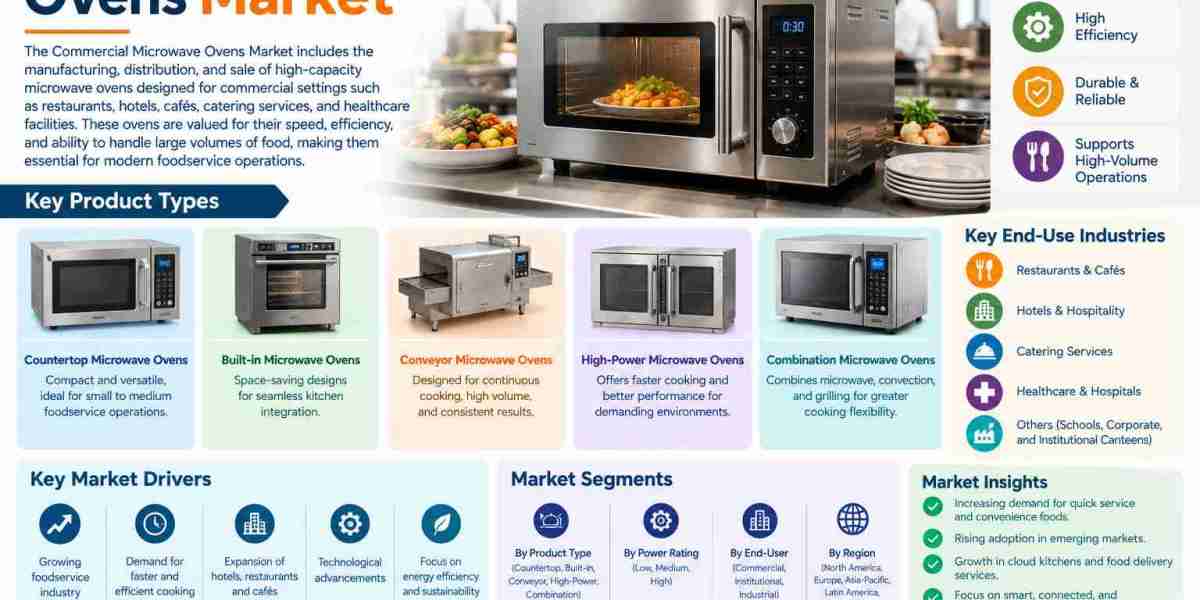

The Commercial Microwave Ovens Market is becoming an important part of modern foodservice operations as restaurants, cafés, hotels, catering businesses, and other professional kitchens look for practical ways to improve food preparation. Commercial microwave ovens are valued for their convenience, operational flexibility, and ability to support different kitchen activities. As foodservice environments become increasingly focused on speed and consistency, microwave technology continues to find new applications across professional kitchens.
One of the important areas connected with this evolution is commercial kitchen microwave equipment, which supports food preparation environments where efficiency and dependable operation are important. Commercial microwave ovens can be incorporated into different kitchen layouts and workflows, allowing operators to organize food preparation around their individual requirements. This flexibility makes them useful in establishments with different menus, service models, and customer expectations.
Commercial microwave ovens are not limited to simple reheating. Modern professional kitchens can use them for cooking, warming, defrosting, and preparing selected food items. Their versatility allows businesses to use a single category of equipment for several operational tasks. This can help simplify kitchen workflows while supporting staff members who need accessible and easy-to-operate cooking equipment.
The changing nature of foodservice is also influencing how commercial kitchens think about equipment. Customers increasingly expect convenient meals and responsive service, while food businesses need to coordinate preparation, cooking, holding, and serving activities. Microwave ovens can become part of this workflow by helping kitchen staff handle specific preparation requirements without interrupting other cooking processes.
Another important trend is the development of user-friendly controls. Commercial kitchen equipment is increasingly designed around usability, allowing employees to operate appliances with greater consistency. Programmable settings, intuitive controls, organized interfaces, and repeatable cooking functions can make equipment easier to integrate into everyday operations. Such features are especially relevant in busy kitchens where different employees may use the same appliance throughout the day.
Energy-conscious operation is also becoming an important consideration for commercial foodservice businesses. Operators are increasingly interested in equipment that can support efficient kitchen processes without compromising functionality. Microwave technology can contribute to streamlined preparation because it is suited to targeted cooking and heating tasks. Manufacturers are therefore exploring ways to improve appliance performance, control, durability, and operational efficiency.
Kitchen space is another factor shaping commercial microwave adoption. Restaurants and cafés often need to make effective use of available workspace. Countertop models can provide flexibility where space is limited, while larger installations may be considered for operations with different capacity requirements. Equipment design therefore plays an important role in helping businesses create organized and practical kitchen environments.
The growing diversity of foodservice formats is also expanding the potential role of commercial microwave ovens. Traditional restaurants may use them alongside other cooking equipment, while cafés, hotels, catering operations, institutional kitchens, and other foodservice settings can incorporate microwave technology into specialized workflows. This wider range of applications creates opportunities for equipment manufacturers to develop products that address specific operational needs.
Technology is expected to remain an important theme in the evolution of the Commercial Microwave Ovens Market. Smart controls, improved interfaces, automated functions, and more adaptable cooking programs can make commercial ovens increasingly suitable for modern kitchen environments. As operators become more comfortable with connected and digitally supported equipment, commercial microwave ovens may become more integrated with broader kitchen management practices.
Future development is likely to focus on balancing convenience, functionality, durability, and ease of maintenance. Professional kitchens need equipment that can support repeated use while remaining practical for staff. Manufacturers that concentrate on dependable construction, straightforward controls, flexible applications, and improved user experiences can address these evolving requirements.
Overall, the Commercial Microwave Ovens Market reflects the broader transformation of professional food preparation. As foodservice businesses seek more organized and efficient workflows, commercial microwave ovens can continue to serve as versatile equipment for cooking, heating, and preparation. Their combination of convenience and flexibility makes them relevant to modern kitchens looking for practical solutions.
FAQs
FAQ 1: What are commercial microwave ovens used for?
Commercial microwave ovens are used in professional kitchens for activities such as cooking, heating, reheating, and defrosting selected food products.
FAQ 2: Why are commercial microwave ovens useful in foodservice operations?
They can support quick and flexible food preparation while fitting into different kitchen workflows and operational environments.