
E-fuels Market to Reach USD 181.2 Billion by 2033
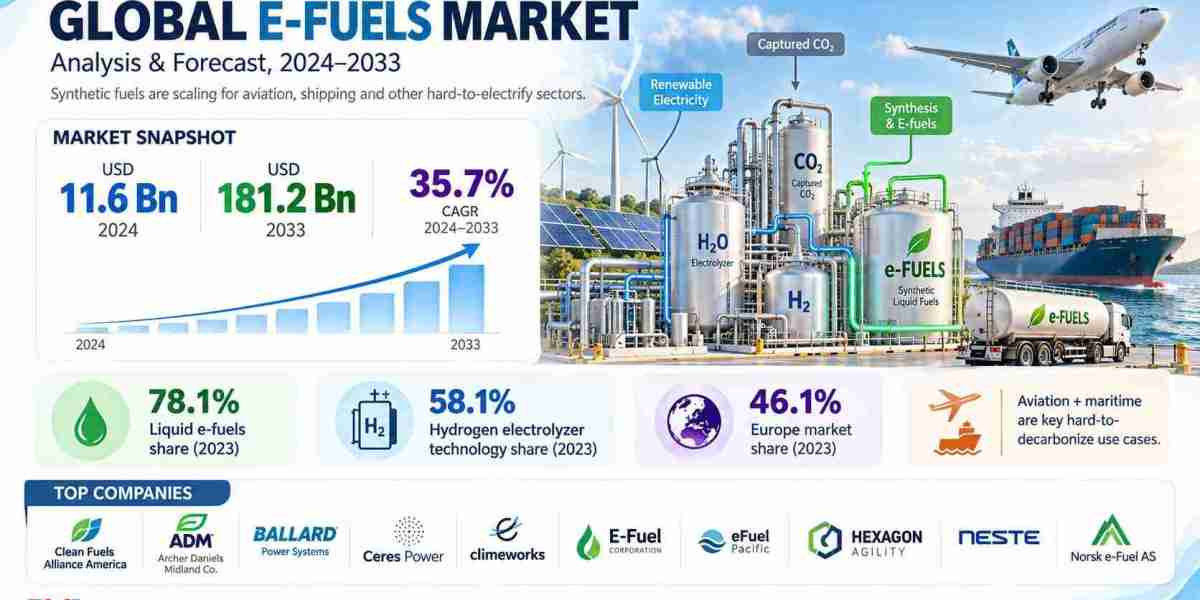
The global E-fuels Market is projected to grow from USD 11.6 billion in 2024 to USD 181.2 billion by 2033, registering a CAGR of 35.7% during the forecast period. According to Dimension Market Research, the market is gaining momentum as aviation, maritime transport, heavy-duty mobility and other hard-to-electrify industries look for lower-carbon fuel solutions that can work with existing infrastructure.
E-fuels, also known as synthetic fuels or power-to-liquid and power-to-gas fuels, are produced using renewable electricity, hydrogen and captured carbon dioxide. Their ability to support decarbonization without requiring complete replacement of existing engines, storage systems and distribution networks is creating strategic opportunities for energy companies, fuel producers, technology providers and industrial investors.
● Market value was USD 11.6 billion in 2024.
● Market value is projected at USD 181.2 billion by 2033.
● The market is expected to grow at 35.7% CAGR.
● Europe accounted for 46.1% market share in 2023.
● Liquid e-fuels held more than 78.1% share in 2023.
Get data you need (request free sample include latest forecast) - Download Now
Why Is the E-fuels Market Growing?
The transition toward low-carbon energy is one of the primary factors supporting e-fuels market growth. While battery-electric technologies can address many transportation applications, sectors such as aviation, shipping and certain industrial processes face limitations related to energy density, range, infrastructure and operational requirements.
E-fuels provide an alternative pathway because many liquid and gaseous synthetic fuels can be designed to work with established fuel systems. This characteristic is particularly important for industries that cannot easily replace existing fleets, engines or infrastructure.
Increasing renewable energy capacity is another important market driver. Solar, wind and hydropower can provide electricity for hydrogen production through electrolysis, while carbon capture technologies can provide carbon dioxide required for certain synthetic fuel pathways. As renewable power becomes more available, companies are increasingly evaluating integrated e-fuel production projects.
Government decarbonization targets and regulatory initiatives are also shaping investment decisions. Aviation and maritime industries are facing increasing pressure to reduce greenhouse gas emissions, creating potential demand for sustainable aviation fuels, e-methanol, e-diesel and other synthetic fuel alternatives.
E-fuels Market Trends and Opportunities
The market is developing around several major commercial and technology trends. Power-to-liquid production is gaining attention because it can convert renewable electricity, hydrogen and carbon dioxide into liquid fuels suitable for applications where energy density and compatibility are important.
Aviation and maritime transportation represent significant opportunity areas. Airlines can potentially use synthetic aviation fuels as drop-in alternatives, while shipping companies can consider e-methanol and other e-fuels for lower-carbon operations.
● Aviation is a major potential application for e-kerosene.
● Shipping is supporting demand for e-methanol and e-diesel.
● Hydrogen electrolyzers support renewable hydrogen production.
● Power-to-liquid accounted for 34.1% share in 2023.
● Carbon capture supports synthetic fuel production pathways.
However, production economics remain a major challenge. E-fuel manufacturing can require substantial renewable electricity, electrolyzer capacity, carbon capture infrastructure and capital investment. High production costs compared with conventional fuels may limit adoption until technology improvements, economies of scale and lower renewable energy costs improve commercial competitiveness.
Competition from battery-electric vehicles, green hydrogen and biofuels also influences market development. As a result, companies evaluating e-fuel investments need to consider application-specific economics, regulatory requirements, technology maturity and infrastructure availability.
E-fuels Market by Technology and Production Method
Hydrogen electrolyzer technology led the technology segment in 2023, accounting for 58.1% market share. Electrolysis is important because hydrogen is a central feedstock for several e-fuel production pathways.
Fischer-Tropsch technology is another important route for producing synthetic liquid hydrocarbons. Reverse Water Gas Shift technology can convert carbon dioxide into carbon monoxide, supporting downstream synthetic fuel production.
Power-to-liquid led the production method segment with more than 34.1% share in 2023. Power-to-gas is also gaining attention for hydrogen and synthetic methane applications, while gas-to-liquid and biologically derived pathways contribute to the broader alternative fuel landscape.
Leading Companies in the Market
● Clean Fuels Alliance America
● Archer Daniels Midland Co.
● Ballard Power Systems, Inc.
● Ceres Power Holding Plc
● Climeworks AG
● E-Fuel Corporation
● eFuel Pacific Limited
● Hexagon Agility
● Neste
● Norsk e-Fuel AS
These companies participate across areas including renewable fuels, hydrogen technology, carbon capture, synthetic fuel production, fuel logistics and related clean-energy technologies.
Regional E-fuels Market Outlook
Europe led the global E-fuels Market in 2023 with a 46.1% share. Strong decarbonization targets, renewable energy investment and regulatory initiatives have encouraged the development of synthetic fuel projects across the region. Germany, Norway and France are among the markets associated with e-fuel technology and infrastructure development.
North America is another important market, supported by clean-energy investment, sustainable aviation fuel initiatives and growing interest in low-carbon fuels. The United States and Canada are developing projects connected with renewable hydrogen, carbon capture and synthetic fuel production.
Asia-Pacific is also emerging as a significant region. China, Japan and South Korea are investing in hydrogen technologies and renewable energy infrastructure, while India's expanding clean-energy ecosystem creates additional potential for e-fuel development.
Latin America and the Middle East and Africa represent emerging opportunities due to renewable energy resources, hydrogen initiatives and investments in alternative fuels.
E-fuels Market Segmentation
The E-fuels Market is analyzed across renewable sources, fuel types, state, technology, production method, end-use application and geography.
● Fuel types include e-methane, e-kerosene and e-methanol.
● Other fuels include e-ammonia, e-diesel and e-gasoline.
● State segments include gas and liquid e-fuels.
● Technologies include electrolysis, Fischer-Tropsch and RWGS.
● Production methods include power-to-liquid and power-to-gas.
● Applications include transportation, chemicals and power generation.
● Regions include North America, Europe, Asia-Pacific and other markets.
Recent E-fuels Industry Developments
The e-fuels industry is moving from technology development toward larger commercial projects. In 2024, HIF Global appointed Techint Engineering and Construction to support engineering work for a large-scale electro-fuel plant in Chile.
Infinium Energy also unveiled its Project Pathfinder facility in Texas, focused on producing e-fuels using green hydrogen and captured carbon dioxide. Other industry developments include collaborations involving Saudi Aramco and Stellantis for e-fuel testing and partnerships between companies such as Uniper, Liquid Wind and Siemens Energy focused on e-methanol and lower-carbon shipping fuels.
These developments indicate growing interest in scaling production, improving technology and establishing commercial supply chains.
Report Also Cover
What is the current E-fuels Market size?
The global E-fuels Market was valued at USD 11.6 billion in 2024 and is projected to reach USD 181.2 billion by 2033.
What is the E-fuels Market growth rate?
The market is projected to expand at a CAGR of 35.7% during the 2024 to 2033 forecast period.
What is driving E-fuels Market growth?
Decarbonization targets, renewable energy expansion, clean-fuel regulations and demand from hard-to-electrify sectors are key growth factors.
Which region leads the E-fuels Market?
Europe led the global market in 2023 with a 46.1% market share.
Which e-fuel segment dominated in 2023?
Liquid e-fuels held more than 78.1% of the market in 2023.
Which technology led the market?
Hydrogen electrolyzer technology led the technology segment with a 58.1% share in 2023.
Which production method led the market?
Power-to-liquid accounted for more than 34.1% of the production method segment in 2023.
Where are e-fuels primarily used?
Key applications include aviation, shipping, heavy-duty transport, industrial heating and power generation.
What are the major challenges facing e-fuels?
High production costs, renewable electricity requirements, infrastructure needs and competition from other low-carbon technologies remain important challenges.
Who are the leading E-fuels Market companies?
Major companies identified in the market include Neste, Norsk e-Fuel AS, Climeworks AG, Ballard Power Systems, Ceres Power Holding, E-Fuel Corporation and other industry participants.
Browse more reports:
About Us
Dimension Market Research (DMR) is a global market intelligence and consulting firm delivering data-driven insights that help organizations make informed strategic decisions. With expertise across 12+ industries and global markets, DMR provides syndicated reports, custom research, competitive analysis, white space analysis, and business strategy consulting.
Our research solutions combine analytical rigor, industry expertise, and forward-looking intelligence to identify opportunities, reduce risks, and support sustainable growth. Trusted by clients across diverse sectors, DMR is committed to delivering accurate, actionable insights that enable businesses to navigate evolving market landscapes with confidence.
Contact Us
Phone USA: +17323699777
Phone India: +919310023843
E-mail: enquiry@dimensionmarketresearch.com
Address USA: 957 Route 33, Suite 12 #308, Hamilton Square, NJ-08690
Address India: D44, Sector 6, Noida 201301, India