
Temperature Data Logger Market to Reach USD 2,618.9 Million by 2035
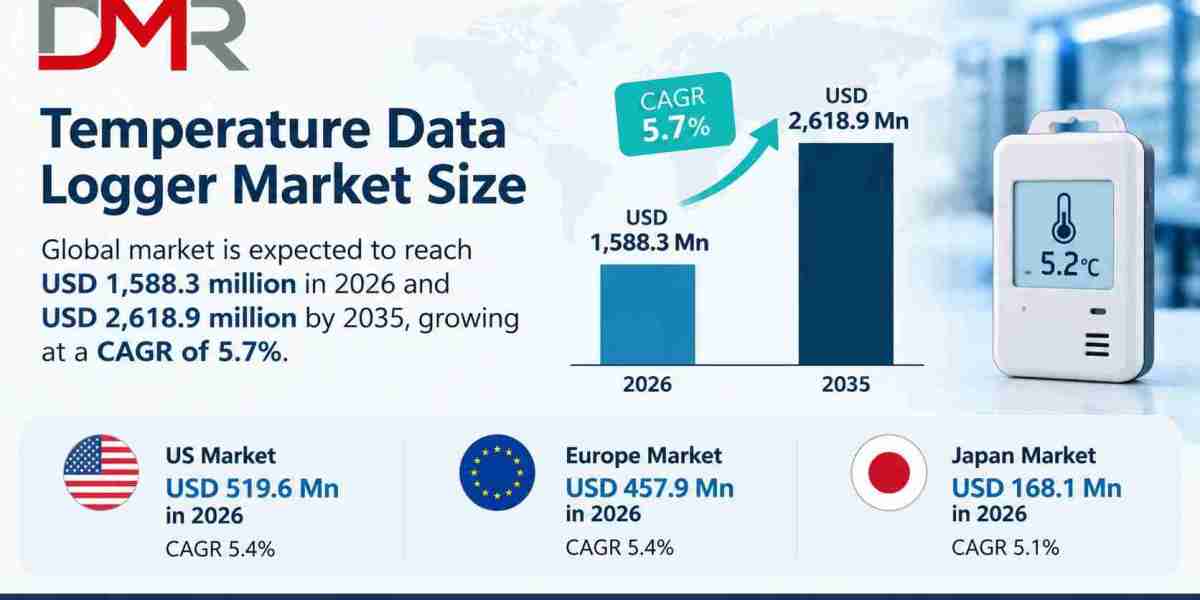
The global Temperature Data Logger Market is expected to reach USD 1,588.3 million in 2026 and is projected to reach USD 2,618.9 million by 2035, expanding at a 5.7% CAGR from 2026 to 2035, according to Dimension Market Research. Market growth is being supported by increasing demand for cold chain monitoring, stricter regulatory requirements, digital supply chain transformation, and the adoption of wireless and cloud-connected temperature monitoring systems.
Temperature data loggers enable organizations to record and monitor temperature conditions across pharmaceutical storage, food logistics, laboratories, warehouses, manufacturing facilities and other temperature-sensitive environments. Increasing demand for real-time visibility is encouraging enterprises to move beyond manual temperature recording toward automated alerts, cloud dashboards, wireless connectivity and predictive analytics.
The pharmaceutical and healthcare sector remains a major application area because temperature-sensitive medicines, vaccines, biologics and laboratory materials require controlled storage and transportation. Food and beverage companies, logistics providers and industrial manufacturers are also increasing investments in temperature monitoring to improve product quality, operational visibility and regulatory compliance.
The Temperature Data Logger Market is being shaped by the transition toward connected monitoring ecosystems. Wireless, Wi-Fi, Bluetooth, USB, cellular and multi-channel data loggers are increasingly being deployed across facilities and transportation networks.
Enterprise buyers are particularly interested in systems that can connect monitoring hardware with cloud platforms, quality management systems, warehouse management systems and enterprise resource planning environments. This integration allows businesses to centralize temperature records, automate reporting and respond more quickly to temperature excursions.
● Global market value reaches USD 1,588.3 million in 2026.
● Market value is projected at USD 2,618.9 million by 2035.
● Global CAGR is estimated at 5.7%.
● North America is projected to hold 38.9% share in 2026.
● Wireless data loggers are a leading product segment.
● Cold chain monitoring is a major application area.
● Pharmaceuticals and healthcare remain a key end-user segment.
Request a Free PDF Brochure (latest forecast include) - Download Now
Regional Temperature Data Logger Market Analysis
North America is projected to remain the leading regional market, supported by its established pharmaceutical and biotechnology industries, advanced cold chain infrastructure and growing adoption of digital monitoring technologies. The US Temperature Data Logger Market is projected to reach USD 519.6 million in 2026 and USD 831.0 million by 2035, representing a 5.4% CAGR.
Europe is estimated at USD 457.9 million in 2026 and is projected to reach USD 735.0 million by 2035, also registering a 5.4% CAGR. Regulatory requirements, pharmaceutical distribution standards and food safety requirements are important factors supporting demand for accurate and reusable temperature monitoring systems.
Japan is projected to reach USD 168.1 million in 2026 and USD 262.2 million by 2035, growing at a 5.1% CAGR. Logistics automation, quality assurance and integration with cloud-based monitoring platforms are supporting demand.
Asia-Pacific is expected to experience rapid market expansion as healthcare infrastructure, pharmaceutical logistics, e-commerce and food distribution networks continue to develop across emerging economies.
Key Market Growth Drivers
The expansion of temperature-sensitive supply chains is one of the most important factors supporting market growth. Pharmaceutical products, vaccines, biologics, food products and chemicals require reliable temperature monitoring throughout storage and transportation.
Regulatory compliance is another significant driver. Organizations increasingly need accurate records, audit trails, automated alerts and validated monitoring processes to support quality assurance and regulatory requirements.
The adoption of IoT-enabled monitoring is creating another growth avenue. Connected data loggers can transmit information to centralized cloud particularly among smaller businesses and organizations operating across cost-sensitive markets. Advanced monitoring programs may require hardware, platforms, allowing businesses to monitor multiple locations remotely and receive alerts when temperature conditions move outside predefined thresholds.
● Cold chain expansion supports monitoring demand.
● Regulatory compliance encourages automated logging.
● IoT enables connected temperature monitoring.
● Cloud platforms improve centralized visibility.
● Wireless devices reduce manual data collection.
Market Restraints and Opportunities
High deployment and calibration costs can limit adoption, particularly among smaller businesses and organizations operating across cost-sensitive markets. Advanced monitoring programs may require hardware, software, calibration, validation, maintenance and connectivity infrastructure.
Connectivity limitations can also affect remote monitoring applications. International shipments and geographically isolated facilities the same time, these challenges create opportunities for manufacturers and technology providers. Demand is increasing for affordable IoT-enabledgers are gaining adoption because they provide flexible deployment and reduce the need for manual data retrieval.
Wi-Fi-enabled systems are also becoming important within facilities where continuous connectivity companies, temperature monitoring specialists, sensor manufacturers and connected wireless industrial technologies, alongside ELPRO's development of centralized management capabilities for USB, Bluetooth reach USD 1,588.3 million in 2026 and USD 2,618.9 million by 2035, growing at a 5.7% provides market size estimates, growth analysis, market trends, competitive landscape assessment, regional analysis and strategic insights designed to help businesses understand the evolving temperature may experience inconsistent network coverage, although offline storage capabilities can preserve measurement records until connectivity is restored.
At the same time, these challenges create opportunities for manufacturers and technology providers. Demand is increasing for affordable IoT-enabled devices, cloud monitoring platforms, cellular connectivity, predictive analytics and integrated quality management solutions.
Technology and Application Trends
Wireless and Bluetooth temperature data loggers are gaining adoption because they provide flexible deployment and reduce the need for manual data retrieval. Wi-Fi-enabled systems are also becoming important within facilities where continuous connectivity and centralized monitoring are required.
Cloud-based temperature monitoring is another major trend. Organizations can use centralized dashboards to monitor warehouses, laboratories, healthcare facilities and transportation operations from a single environment.
AI is further expanding the capabilities of temperature monitoring systems. Predictive analytics can examine historical temperature patterns, equipment performance and transportation conditions to help identify potential excursions or maintenance requirements before they become operational problems.
Major application areas include:
● Pharmaceutical storage and transportation
● Food and beverage monitoring
● Cold chain logistics
● Laboratory monitoring
● Warehouse monitoring
● HVAC monitoring
● Industrial process monitoring
● Environmental monitoring
Product and Connectivity Segmentation
The market is segmented by product type, connectivity, deployment, measurement range, application and end user. Product categories include wireless, USB, Bluetooth, Wi-Fi, multi-channel, single-use and reusable temperature data loggers.
Wireless temperature data loggers are expected to maintain strong demand because they support remote access, automated alerts and cloud integration. Wi-Fi connectivity is also projected to remain important due to its ability to provide continuous data transmission within connected facilities.
Portable data loggers are widely used for transportation and field monitoring, while fixed systems support permanent monitoring environments such as warehouses, laboratories and manufacturing facilities.
Low-temperature monitoring represents a significant opportunity because pharmaceuticals, vaccines, biologics, blood products and perishable foods frequently require controlled refrigerated conditions.
Competitive Landscape
The competitive environment includes global test and measurement companies, temperature monitoring specialists, sensor manufacturers and connected IoT solution providers. Competition increasingly extends beyond hardware performance to software integration, cloud connectivity, predictive analytics, calibration services and regulatory support.
Prominent companies covered in the market include Emerson Electric Co., Honeywell International Inc., Testo SE & Co. KGaA, ELPRO-BUCHS AG, Sensitech Inc., Vaisala Oyj, Dickson Company, Onset Computer Corporation, DeltaTrak Inc., Rotronic AG, Omega Engineering Inc., Thermo Fisher Scientific Inc., Fluke Corporation, MadgeTech Inc., T&D Corporation, Signatrol Ltd., Berlinger & Co. AG, Hanwell Solutions Ltd., InTemp by Onset, and Control Company.
Recent developments include Emerson's introduction of temperature monitoring and wireless industrial technologies, alongside ELPRO's development of centralized management capabilities for USB, Bluetooth and IoT temperature data loggers.
Report Also Cover
What is the expected size of the Temperature Data Logger Market?
The global Temperature Data Logger Market is projected to reach USD 1,588.3 million in 2026 and USD 2,618.9 million by 2035, growing at a 5.7% CAGR.
What is driving the Temperature Data Logger Market?
Key growth factors include cold chain expansion, regulatory compliance, digital transformation, wireless monitoring and increasing demand for real-time temperature visibility.
Which region leads the Temperature Data Logger Market?
North America is projected to lead the market, with an estimated 38.9% share in 2026.
Which country has a major Temperature Data Logger Market?
The United States represents a major national market, supported by pharmaceutical, healthcare, logistics and cold chain monitoring demand.
What are the major Temperature Data Logger Market trends?
Key trends include wireless connectivity, Bluetooth monitoring, cloud integration, IoT-enabled devices, AI-powered analytics and sustainable single-use or recyclable solutions.
Which product type is expected to lead?
Wireless temperature data loggers are projected to maintain strong demand because of their remote monitoring, scalability and cloud connectivity capabilities.
Which connectivity technology is important?
Wi-Fi is projected to remain a leading connectivity technology because it enables continuous data transmission and centralized monitoring.
Which application dominates the market?
Cold chain monitoring is a major application because pharmaceuticals, food products, vaccines and biologics require controlled temperature conditions.
Which end-user segment is significant?
Pharmaceuticals and healthcare represent a major end-user segment due to stringent temperature control and quality requirements.
What is the outlook for the market through 2035?
The market is projected to expand from USD 1,588.3 million in 2026 to USD 2,618.9 million by 2035, reflecting a 5.7% CAGR.
Browse more reports:
● Japan Distributed Control System Market
● Electroplating Chemical Market
● Geo-polymer Cement Chemical Market
About Us
Dimension Market Research (DMR) is a global market intelligence and consulting firm delivering data-driven insights that help organizations make informed strategic decisions. With expertise across 12+ industries and global markets, DMR provides syndicated reports, custom research, competitive analysis, white space analysis, and business strategy consulting.
Our research solutions combine analytical rigor, industry expertise, and forward-looking intelligence to identify opportunities, reduce risks, and support sustainable growth. Trusted by clients across diverse sectors, DMR is committed to delivering accurate, actionable insights that enable businesses to navigate evolving market landscapes with confidence.
Contact Us
Phone USA: +17323699777
Phone India: +919310023843
E-mail: enquiry@dimensionmarketresearch.com
Address USA: 957 Route 33, Suite 12 #308, Hamilton Square, NJ-08690
Address India: D44, Sector 6, Noida 201301, India