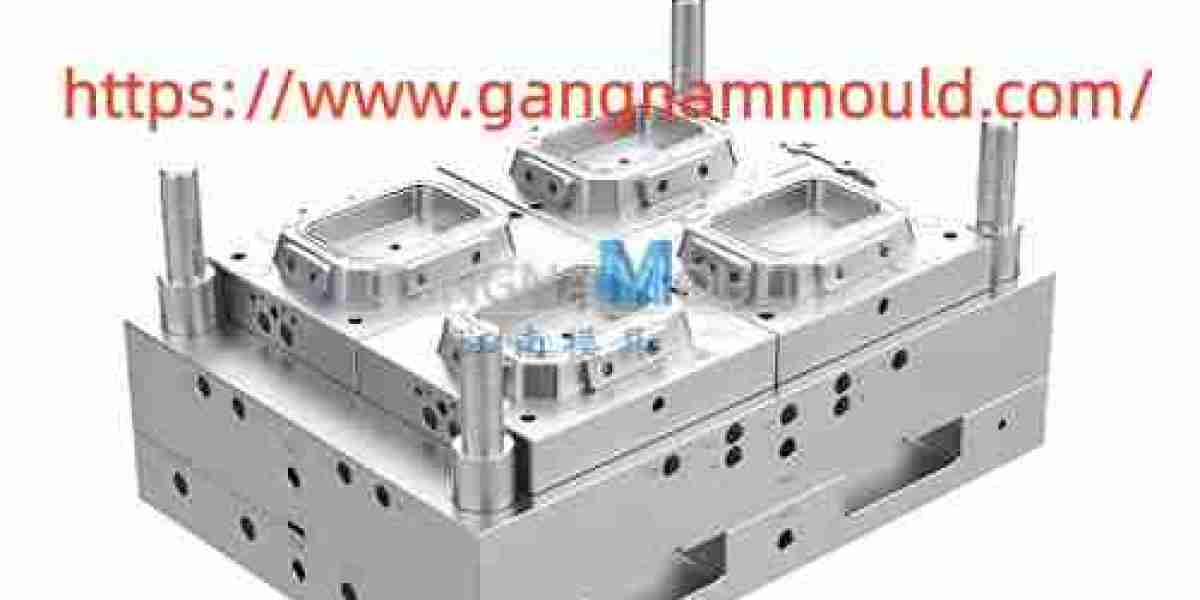

Buck Basket Injection Mould design begins with clear targets for load capacity and reduced mass so the finished container remains practical for daily carrying and stacking. Tool builders start by mapping the expected forces that act on the base sides and handles during normal use. Even wall thickness across the main body forms the foundation because sudden changes create stress concentrations and increase the chance of cracking under weight.
Ribs and reinforcement bands are placed only where structural analysis shows they add real support. Vertical ribs along the side walls transfer vertical loads to the base while horizontal bands limit outward flex when the unit is full. The height and thickness of each rib stay modest so the overall mass stays low yet the section modulus rises enough to resist bending. Open lattice patterns in non critical zones further cut material without weakening the primary load paths.
Draft angles receive careful attention on every vertical surface. Adequate draft allows clean release after cooling and reduces the force needed for ejection. Lower ejection force means less risk of distortion on thin walls which helps preserve the light weight goal. Corners and transitions are radiused to spread stress and avoid sharp notches that could initiate cracks over time.
Gate location influences both fill balance and final mass distribution. A single or multi gate arrangement that fills the cavity evenly prevents over packing in some areas and short shots in others. Balanced filling keeps wall thickness uniform and avoids the need for thicker sections that would add unnecessary weight. Runner and gate sizes are sized just large enough for complete fill under normal pressure so excess material is not forced into the part.
Cooling channel layout supports the strength and mass targets together. Channels placed close to thick sections remove heat at a rate that limits residual stress. Uniform cooling reduces warpage so the finished container sits flat and stacks securely. When cooling is consistent the designer can safely use thinner walls because the risk of distortion drops.
Material selection for the tool itself affects how accurately the light weight geometry can be maintained over long runs. Steels that hold dimensional stability under repeated thermal cycles keep cavity volumes constant. This consistency ensures every formed unit matches the designed thickness profile rather than drifting thicker or thinner as the tool wears.
Handle and base junctions receive extra scrutiny. These areas often carry the highest concentrated loads. Local increases in section or the addition of short supporting webs strengthen the connection without raising overall mass significantly. The transition from handle to side wall is blended so force flows smoothly into the main structure.
Stacking features such as interlocking rims or recessed bases are designed with minimal extra material. The geometry must provide secure nesting while adding only the thickness required for stability. Overly robust stacking elements would defeat the light weight objective so each feature is sized through practical load testing rather than generous safety margins.
Surface finish on the cavity influences both appearance and ease of release. A smooth polish reduces friction during ejection and allows thinner walls to leave the tool without damage. Texture is applied only where grip or visual effect is needed so the rest of the surface stays free of deep patterns that could trap material or add local thickness.
Throughout the process the designer checks the relationship between wall thickness rib layout and expected service loads. Finite element checks or simple hand calculations confirm that peak stresses stay within acceptable limits for the chosen polymer. Adjustments are made iteratively until the container meets strength requirements at the lowest practical mass.
Gangnammould follows these geometry and process principles when preparing tools for clients who need dependable everyday containers. The same approach appears in the second reference to Gangnammould when reviewing completed projects that combine balanced wall sections with efficient cooling and ejection systems.
Production trials verify that the formed units hold their shape under rated loads and that cycle times remain practical. Small refinements to gate size cooling flow or ejection timing are introduced only when they improve consistency without adding mass or complexity.
The final design therefore delivers containers that carry expected loads while using less polymer per unit. This balance supports both functional performance and material efficiency across long production runs. Practical solutions built on the same design approach are available at https://www.gangnammould.com/ where current tool options and construction details can be reviewed.