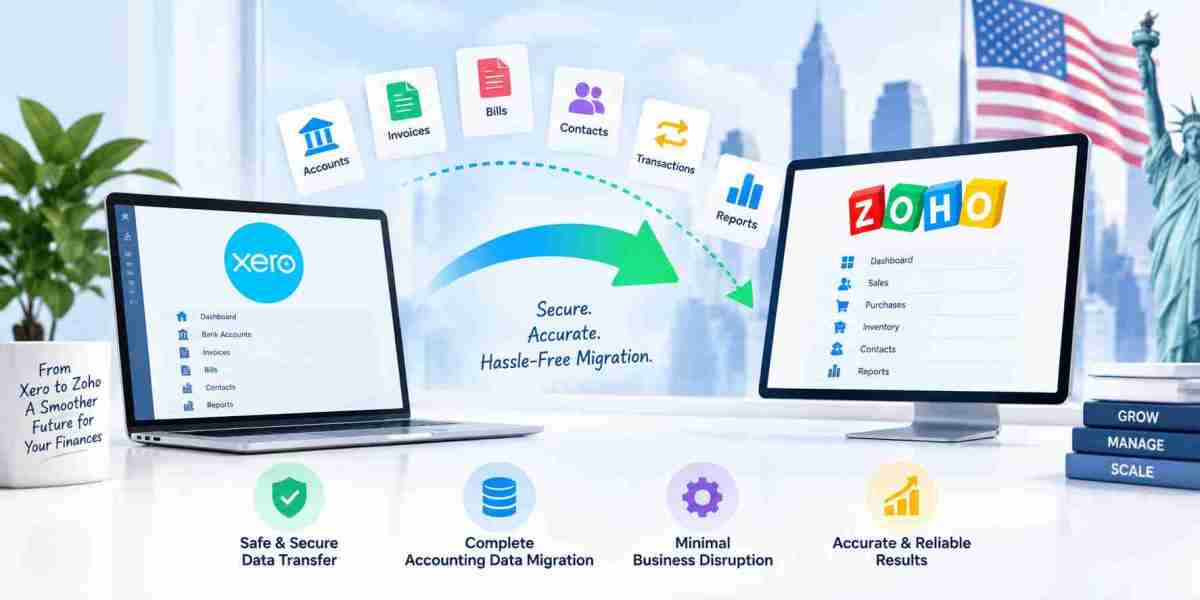

Moving from one accounting platform to another is more than exporting a few spreadsheets and importing them into a new system. Financial records, customer information, invoices, payments, products, tax details, and historical transactions all need to remain accurate and properly organized. For businesses moving from Xero to Zoho Books, understanding what data can be migrated is one of the most important parts of planning the transition.
With the right Xero to Zoho Migration Services in USA, businesses can move essential accounting information while reducing manual data entry and minimizing the risk of missing important records. A well-planned migration also helps teams start working in Zoho Books without unnecessarily disrupting their day-to-day financial operations.
This guide explains what data can typically be migrated from Xero to Zoho Books, what businesses should prepare before migration, how data mapping works, and how Vision Infotech can help businesses manage the transition.
Understanding Xero to Zoho Migration
Xero and Zoho Books are both cloud-based accounting platforms, but they organize and manage financial information differently. Because of these differences, migration is not simply a matter of copying information from one platform into another.
Professional Xero to Zoho Migration Services in USA generally involve reviewing the existing Xero account, identifying the information that needs to be transferred, mapping Xero fields to their corresponding Zoho Books fields, preparing the data, importing it, and validating the results.
The exact migration scope depends on the business, its Xero configuration, the Zoho Books edition being used, available import options, and the type of historical data involved.
For example, a small consulting company may primarily need customers, invoices, payments, expenses, and account balances. A larger company may also need products, vendors, tax information, bank-related records, recurring transactions, and historical financial information.
What Data Can Be Migrated From Xero to Zoho Books?
One of the first questions businesses ask when considering Xero to Zoho Migration Services in USA is which records can actually be transferred.
The answer depends on the specific data structure and the migration method, but several major categories of accounting information can generally be prepared for migration.
Customer and Contact Information
Customer records are among the most important pieces of information to transfer.
Depending on the available source data and destination configuration, customer information may include:
- Customer names
- Billing addresses
- Shipping addresses
- Email addresses
- Phone numbers
- Contact persons
- Payment terms
- Tax-related information
- Customer reference details
Accurate customer information is important because invoices, payments, statements, and sales transactions depend on properly matched customer records.
Before migration, duplicate customer records should be reviewed. For example, “ABC Manufacturing LLC” and “ABC Manufacturing” could potentially represent the same customer. Importing both without reviewing them could create unnecessary duplicates in Zoho Books.
Vendor and Supplier Data
Businesses can also prepare supplier or vendor information for migration.
Vendor records may include business names, contact details, billing information, payment terms, tax information, and other relevant fields supported by the destination system.
Keeping vendor information organized helps businesses continue their purchasing and accounts payable processes after moving to Zoho Books.
Chart of Accounts
The chart of accounts is one of the most important areas of an accounting migration.
It defines how income, expenses, assets, liabilities, and equity are categorized. Xero and Zoho Books may use different account structures, names, numbering systems, or classifications.
Therefore, Xero to Zoho Migration Services should include careful account mapping rather than blindly importing account names.
For example, an existing Xero account called “Software Subscriptions” may need to be mapped to an appropriate expense account in Zoho Books. The objective is to preserve the financial meaning of the original records while adapting them to the new accounting environment.
Invoices and Sales Transactions
Sales invoices are another major category businesses may want to migrate.
Depending on the migration scope, invoice information can include customer details, invoice numbers, invoice dates, due dates, line items, quantities, prices, taxes, discounts, and outstanding balances.
Historical invoices are particularly important when businesses need to maintain customer account histories.
Consider a company that has been operating for five years and has hundreds of customer invoices in Xero. Starting from scratch in Zoho Books would make it difficult to understand previous billing activity. Migrating appropriate historical records allows the business to maintain continuity.
Bills and Purchase Transactions
Supplier bills and purchase information may also be included in a migration project.
These records can help businesses maintain accounts payable information and understand outstanding obligations.
For example, if a supplier invoice was recorded in Xero but remains unpaid at the time of migration, its status and financial impact need to be handled correctly in Zoho Books.
This is one reason professional Xero to Zoho Migration Services in USA can be valuable for businesses with substantial historical accounting information.
Payments and Transaction History
Migrating invoices without considering their related payments can create inaccurate customer balances.
Payment records may therefore need to be reviewed alongside invoices and outstanding receivables.
Businesses should identify:
- Paid invoices
- Partially paid invoices
- Unpaid invoices
- Customer payments
- Supplier payments
- Payment dates
- Payment amounts
- Related transaction references
The objective is to ensure that customer and vendor balances remain understandable after the transition.
Historical transaction requirements should be decided before migration because businesses do not always need every historical record inside the new system.
Products and Services
Businesses that sell products or standardized services may also need their item information transferred.
Product or service records can include names, descriptions, rates, sales information, purchase information, tax settings, and other supported fields.
For example, an IT services company might have separate service items for software development, technical support, consulting, and maintenance. Moving these items correctly can make invoice creation in Zoho Books much easier.
Businesses should also review duplicate or outdated products before importing them.
Tax Information
Tax data requires particular attention because incorrect tax mapping can affect invoices and financial reporting.
Businesses may need to review tax rates, tax names, tax treatment, and the relationship between tax settings and transaction records.
The appropriate configuration depends on the company's location, business structure, transactions, and applicable tax requirements. A migration should preserve the underlying financial information without assuming that tax settings from Xero can always be copied directly into Zoho Books.
Bank and Financial Information
Bank-related information can be another important part of the migration process.
Depending on the migration method and supported fields, businesses may need to address bank accounts, transaction histories, opening balances, and reconciliation-related information.
However, businesses should not assume that every bank feed connection can simply be transferred from one platform to another. Bank-feed connections often need to be configured again in the destination environment.
The migration plan should therefore distinguish between historical accounting data and live banking connections.
Opening Balances
Opening balances are particularly important when a business chooses to migrate selected historical data instead of its complete accounting history.
The opening balance represents the financial position being carried into the new accounting system at a specific point in time.
If opening balances are incorrect, reports in Zoho Books may not accurately reflect the company's financial position.
A professional migration process should therefore reconcile opening balances against the relevant financial reports before the new system becomes the primary accounting platform.
What About Historical Data?
Historical data migration depends heavily on the business's objectives.
Some businesses want several years of detailed transactions available in Zoho Books. Others prefer to migrate current customers, open invoices, outstanding bills, balances, and essential master data while retaining older information separately.
There is no universal migration period that works for every organization.
A business should consider how frequently historical transactions are accessed, reporting requirements, audit needs, internal processes, and storage of the original Xero records.
Xero to Zoho Migration Services in USA can be structured around the required migration period rather than transferring unnecessary information simply because it exists.
Data Mapping: The Most Important Part of Migration
Data mapping connects information in Xero with the appropriate fields and records in Zoho Books.
For example:
Xero Customer Name → Zoho Books Customer Name
Xero Invoice Number → Zoho Books Invoice Number
Xero Account → Zoho Books Account
Xero Tax Rate → Zoho Books Tax Configuration
This process becomes more complicated when field names, account structures, tax settings, or transaction formats differ.
Good mapping also helps prevent common issues such as duplicate customers, incorrect account classifications, missing invoice information, and inaccurate balances.
This is where Zoho Consulting services can provide additional value. Experienced consultants can review the business's existing accounting workflow and help determine how the destination system should be structured before importing data.
How Businesses Should Prepare Before Migration
Preparation can significantly reduce migration problems.
Review Existing Xero Data
Start by identifying which records are active, outdated, duplicated, or incomplete.
Old contacts and unused products may not need to be transferred.
Clean Duplicate Records
Duplicate customers, vendors, accounts, or products can create confusion in Zoho Books.
Cleaning the source data before migration is usually easier than correcting hundreds of duplicate records afterward.
Decide the Migration Period
Determine whether the business needs complete historical transactions or only selected financial records.
This decision affects the complexity, duration, and validation requirements of the project.
Create a Data Mapping Plan
Each important Xero field should have a corresponding destination field or a documented reason for exclusion.
Back Up Existing Information
Businesses should retain an appropriate copy of their existing accounting information before making major changes.
Test Before Going Live
A test migration can reveal formatting problems, missing fields, duplicate records, or balance discrepancies before the final migration.
Xero Migration vs. QuickBooks to Zoho Books Migration
Businesses sometimes evaluate different accounting platforms before selecting Zoho Books.
The requirements for QuickBooks to Zoho Books Migration can differ from a Xero migration because the source platforms use different data structures and workflows.
Similarly, businesses that use Zoho CRM alongside Zoho Books may have additional integration and customer-data requirements.
The migration strategy should therefore be based on the actual source system rather than applying one generic process to every accounting migration.
How Zoho CRM Can Fit Into the Migration Strategy
Accounting data is only one part of a company's overall business information.
If a company also uses Zoho CRM, it may need to think about how customer, sales, and accounting information will work together.
Zoho CRM Customization Services in USA can help businesses adapt CRM workflows, fields, modules, and automation to their operational requirements.
For example, a company may use Zoho CRM for leads and sales opportunities while using Zoho Books for invoicing and financial management. Connecting these systems appropriately can reduce duplicate data entry and improve information flow between sales and accounting teams.
Common Migration Challenges
Even when the migration appears straightforward, businesses may encounter several challenges.
Different field structures can make mapping difficult. Historical transactions may contain incomplete information. Duplicate records can create inconsistencies. Tax settings may require redesign rather than direct copying. Some information may also need manual review because it does not have a direct equivalent in the destination platform.
Another challenge is timing.
A business cannot simply stop accounting operations for several days while data is being prepared. Migration planning should consider the period during which new transactions continue to occur in Xero.
A clear cutover strategy can help reduce the possibility of missing transactions.
Why Choose Vision Infotech for Xero to Zoho Migration?
Vision Infotech helps businesses approach accounting technology migration with a structured and business-focused process.
Rather than treating migration as a basic file-import exercise, Vision Infotech can help businesses review their existing workflows, understand their data structure, prepare information for migration, configure Zoho Books, and validate important records.
The team can also support businesses that need broader Zoho solutions beyond accounting migration. This can include Zoho Consulting services, CRM customization, business automation, and integration requirements.
A business may also need assistance after the migration is completed. Teams may need help understanding new workflows, configuring automation, connecting applications, or improving reporting. Having a broader Zoho implementation approach can make the transition more practical for growing organizations.
The goal should be a clean and organized move that supports everyday accounting operations rather than simply transferring files from one platform to another.
Final Thoughts
A successful accounting migration depends on more than moving data from Xero into Zoho Books. Customer records, vendors, accounts, invoices, bills, payments, products, tax information, opening balances, and historical transactions all need to be reviewed according to the business's requirements.
With professional Xero to Zoho Migration Services in USA, businesses can create a structured migration plan, map their data correctly, identify potential issues early, and validate important financial information before going live.
The right approach starts with understanding what data the business actually needs, cleaning the source information, preparing accurate mappings, testing the migration, and confirming financial balances afterward.
For businesses looking beyond basic accounting migration, Vision Infotech can also support related Zoho requirements, including Zoho Consulting services, CRM customization, integrations, and business automation. With the right planning and technical guidance, moving from Xero to Zoho Books can become a controlled transition that supports more organized accounting and connected business operations.