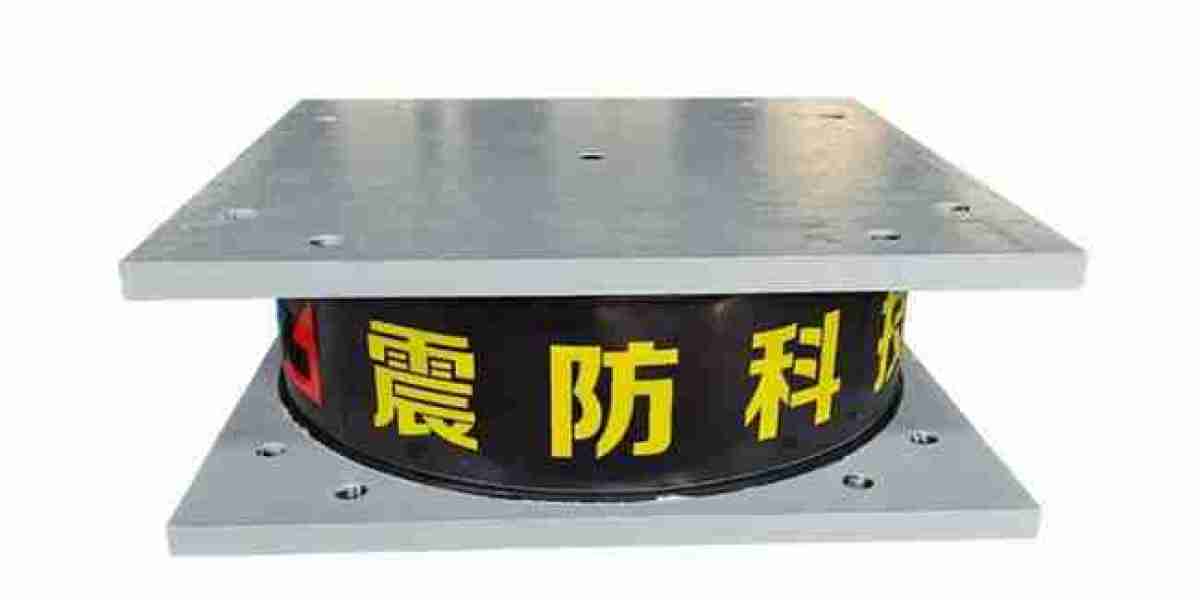

A Building Isolation Rubber Bearing is not simply a thick piece of rubber placed between a building and its foundation. If a solid rubber block were made large enough to carry a substantial building load, its horizontal behavior would not necessarily provide the flexibility required for seismic isolation. The laminated structure addresses this problem by dividing the rubber into multiple thinner layers separated by steel plates.
The steel plates constrain the rubber layers in the vertical direction while allowing the overall bearing to deform horizontally. Under the weight of the building, the laminated stack provides substantial vertical load-carrying capacity. During horizontal movement, however, the rubber layers can shear relative to their original position. This combination allows one component to provide different stiffness characteristics in different directions.
Layer thickness is therefore an important design variable. Thinner rubber layers generally provide greater control over the deformation of each individual layer, while the total number of layers contributes to the overall height and movement capacity of the bearing. The steel plates also need to maintain their intended geometry so that the vertical load is distributed consistently through the laminated stack.
Some isolation bearings incorporate a lead core in the center. In this configuration, the rubber and steel layers continue to provide the basic isolation mechanism, while the lead core contributes additional energy dissipation through plastic deformation during horizontal movement. The resulting behavior differs from that of a plain laminated rubber bearing, so the choice between configurations depends on the requirements of the structural isolation system.
Installation accuracy is another important part of bearing performance. The bearing transfers forces between the superstructure and the foundation, which means the supporting surfaces and connection components need to be correctly positioned. Problems with elevation, alignment, or bearing placement can affect how evenly the load is transferred through the laminated structure.
The surrounding construction also needs to accommodate the expected horizontal movement. A bearing may allow the building to move relative to its foundation during seismic loading, but adjacent structural elements, utility connections, expansion gaps, and other components must have enough allowance for that movement. The bearing cannot be evaluated independently from the space and connections around it.
These bearings can be incorporated into different types of structures, including residential and commercial buildings as well as facilities where continuity of operation is particularly important. Their use is generally considered during structural design because the isolation layer affects the relationship between the foundation and the superstructure.
A Building Isolation Rubber Bearing therefore depends on more than the rubber material itself. The rubber layers, steel plates, optional damping core, connection details, and installation conditions all contribute to the final behavior. Understanding how these elements interact helps explain why laminated construction is central to the design of building seismic isolation systems.