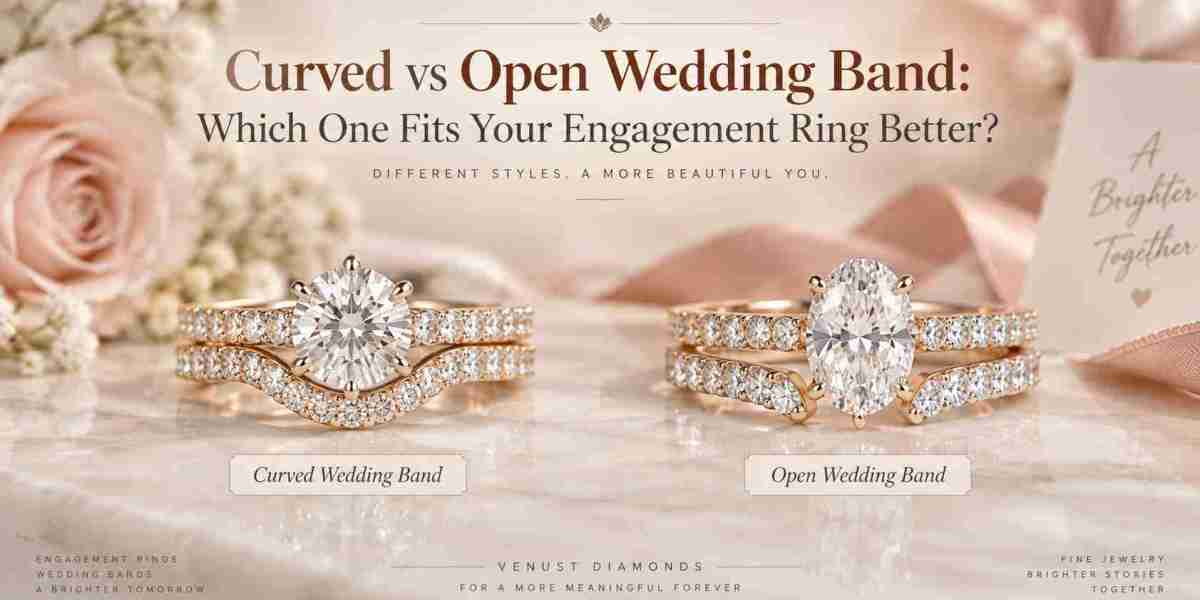

Finding a wedding band that sits well beside your engagement ring can be harder than choosing the engagement ring itself. Some settings leave enough room for a straight band while others need a shape that works around the center stone.
The Curved vs Open Wedding Band choice mainly depends on your engagement ring setting, how close you want the two rings to sit and the overall look you prefer. A curved band follows the outline of the engagement ring. An open band leaves space in the center so a larger or lower setting can fit between its ends.
Both can create a balanced ring stack. The better option depends on how your engagement ring is built.
What Is a Curved Wedding Band?
A curved wedding band has a gentle contour in the center. The curve is designed to follow the shape of an engagement ring so both pieces can sit closer together.
The depth of the curve can vary. Some bands have a subtle arc while others have a deeper contour for large center settings.
A curved wedding band can work especially well with:
- Low-set engagement rings
- Halo settings
- Bezel-set center stones
- Large center stones
- Cluster engagement rings
- Rings with decorative baskets
When comparing Curved vs Open Wedding Band styles, the curved option usually gives the stack a softer and more traditional shape.
What Is an Open Wedding Band?
An open wedding band does not connect across the center. Instead, there is an intentional gap between the two ends of the band.
That space allows the engagement ring setting to sit inside the opening. This can help when a traditional straight band or even a curved band cannot fit closely enough.
Open bands may feature:
- Round stones on each side
- Pear-shaped stones
- Marquise stones
- Baguette accents
- Plain polished ends
- Pavé-set sides
The opening also creates a more modern look. It can make the engagement ring appear framed without adding another solid line directly below the center stone.
Curved vs Open Wedding Band: Quick Comparison
| Feature | Curved Wedding Band | Open Wedding Band |
|---|---|---|
| Shape | Continuous band with a center curve | Band with an intentional center opening |
| Best for | Low-set or contoured engagement rings | Wide, low or unusual center settings |
| Overall look | Classic and flowing | Modern and distinctive |
| Fit | Follows the engagement ring outline | Gives the setting space between both ends |
| Stone options | Pavé, eternity or plain | Accent stones near the opening or along the band |
| Stack appearance | Connected and seamless | More open and airy |
| Versatility alone | Usually looks like a complete band | Can look more design-focused when worn alone |
The main Curved vs Open Wedding Band difference is how each style makes room for the engagement ring. One bends around the setting while the other leaves the center open.
When Does a Curved Wedding Band Work Best?
A curved band is usually a strong choice when your engagement ring needs some extra space but you still want the wedding band to look complete on its own.
Choose a curved style when you want:
- A close engagement ring and wedding band fit
- A softer outline around the center stone
- A traditional bridal stack
- One continuous wedding band
- A contour that follows a halo or bezel setting
Curved bands can also work well when the engagement ring basket extends lower toward the finger. The center curve gives that basket extra room.
The Curved vs Open Wedding Band decision may come down to how much space your setting needs. If a moderate curve is enough to clear the engagement ring, there may be no need for an open design.
When Is an Open Wedding Band a Better Fit?
An open band becomes useful when the engagement ring has a large or unusual setting that needs more space than a standard contour can provide.
For example, some engagement rings have wide halos or side details near the base of the center stone. A curved band may still leave a gap. An open band can allow the entire setting to sit within the center space.
Consider an open band if you have:
- A wide center setting
- A large halo
- A low basket
- A prominent bezel setting
- A wide three-stone design
- A ring with unusual side details
Open bands can also appeal to shoppers who want the wedding band to feel more modern.
When considering Curved vs Open Wedding Band designs, remember that fit is only one factor. Your personal style also matters.
Which Style Sits More Flush With an Engagement Ring?
Either style can create a close fit. The engagement ring design determines which one works better.
A curved band sits flush when its contour closely matches the shape of the engagement ring. If the curve is too shallow, there may still be a visible gap.
An open band works differently. The engagement ring setting sits between the two open ends. This can create a close appearance even when the center setting is too wide for a curved band.
The best way to compare Curved vs Open Wedding Band options is to look at the engagement ring from the side as well as from the top. The side view shows how low the basket sits and where the wedding band may touch the setting.
Does the Center Stone Shape Matter?
Yes. The center stone shape can affect how the final stack looks even though the setting is usually more important than the stone itself.
Round and Oval
Round and oval stones work with many curved bands. A gentle contour can follow the lower edge of the center setting.
Pear and Marquise
These elongated shapes can look especially attractive with curved or open designs. The pointed ends create more visual movement within the stack.
Emerald and Radiant
Rectangular stones can pair well with open bands because the opening can frame their structured shape.
Cushion and Princess
These shapes can work with either option depending on how the basket and prongs are positioned.
If you are shopping for a coordinated stack, compare different Moissanite Wedding Bands with your engagement ring style rather than choosing a band based only on the center stone shape.
Should Your Wedding Band Sit Flush?
Not necessarily.
Some people prefer a completely flush stack with almost no visible space between the rings. Others like a small gap because it helps each ring keep its own shape and character.
A flush fit can create a polished and coordinated appearance. A slight gap can make the engagement ring stand out more.
For the Curved vs Open Wedding Band decision, focus on what looks intentional rather than trying to remove every small space.
Can You Wear a Curved or Open Band Alone?
A curved band can usually be worn on its own. A subtle curve may look decorative even without an engagement ring. A deeper contour can look more unusual when worn alone.
An open band is naturally more distinctive. Some designs still look complete by themselves while others are clearly intended to frame another ring.
If you expect to wear your wedding band without your engagement ring regularly, consider how the band looks by itself before making your choice.
How to Choose Between a Curved and Open Wedding Band
Use these five checks before deciding:
- Look at your engagement ring setting.
Check whether the basket, halo or bezel extends beyond the shank. - Check the setting height.
A low setting may need more clearance. - Decide how close you want the rings.
Choose a contour or opening that gives you the spacing you prefer. - Think about the overall style.
Curved bands feel softer. Open bands tend to look more contemporary. - Check how the band looks alone.
This matters if you will sometimes wear only the wedding band.
The right Curved vs Open Wedding Band choice should work with your engagement ring rather than compete with it.
Which One Fits Your Engagement Ring Better?
There is no single shape that fits every engagement ring. A curved band is a strong choice when you want a continuous ring with a smooth contour around your setting. It works especially well when the engagement ring needs moderate clearance.
An open band can be better when the setting is wider, lower or more unusual. Its center opening gives the engagement ring more space while adding a modern look to the stack.
When comparing Curved vs Open Wedding Band styles, check the ring profile, setting width, spacing and how the pair looks together. The best match is the one that makes both rings feel like they belong in the same stack.