
Microbial Fermentation Technology Small Molecules Sector to Reach USD 68.3 Billion by 2035
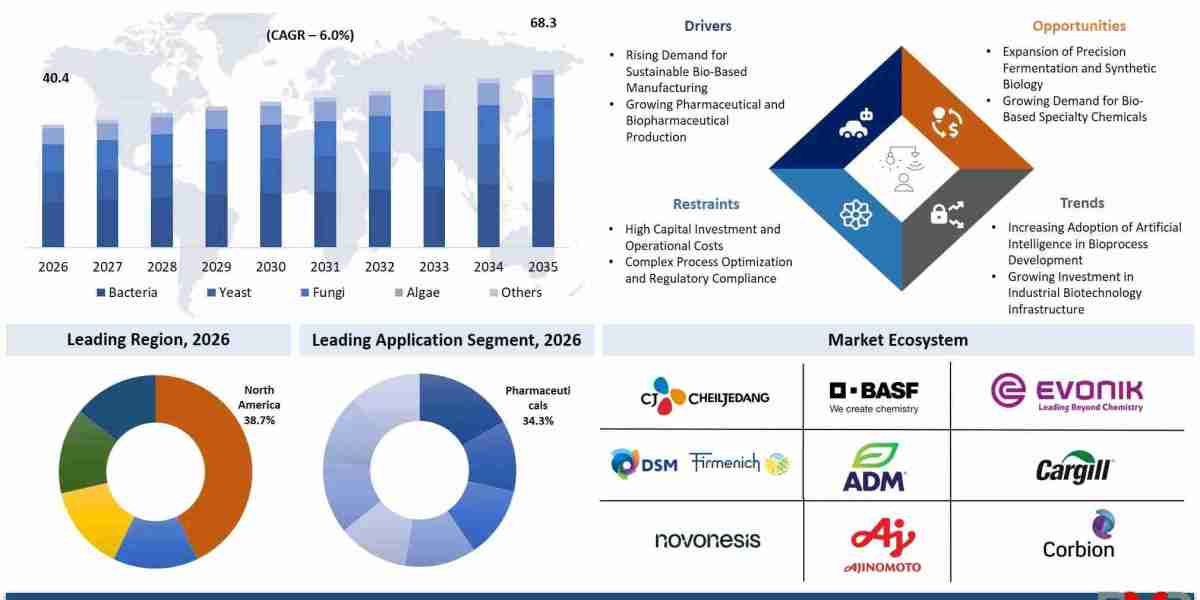
According to Dimension Market Research, the Global Microbial Fermentation Technology Small Molecules Sector is projected to reach USD 40.4 billion in 2026 and expand to USD 68.3 billion by 2035, registering a 6.0% CAGR. Growing adoption of sustainable biomanufacturing, precision fermentation, synthetic biology, and advanced strain engineering is strengthening demand for fermentation-derived amino acids, organic acids, vitamins, antibiotics, enzymes, and specialty small molecules.
Microbial fermentation is becoming increasingly important as pharmaceutical, biotechnology, food, nutrition, and chemical companies seek scalable alternatives to conventional petrochemical and chemical synthesis. Engineered bacteria, yeast, fungi, and other microorganisms are being optimized to manufacture high-value molecules with improved selectivity, process efficiency, and resource utilization.
The market is also benefiting from greater investment in microbial strain development, fermentation process optimization, automation, digital bioprocessing, downstream purification, and commercial-scale manufacturing. Biotechnology companies are increasingly assessing fermentation platforms not only for sustainability benefits, but also for supply security, production economics, product consistency, and faster commercialization of new molecules.
Key Market Highlights
- Global market reaches USD 40.4 billion in 2026.
- Market value is projected at USD 68.3 billion by 2035.
- Global growth is forecast at a 6.0% CAGR through 2035.
- The U.S. market is valued at USD 13.1 billion in 2026.
- North America accounts for 38.7% of the 2026 market.
- Amino acids represent a leading product category.
- Fed-batch fermentation remains a major production process.
- Commercial-scale manufacturing leads production-scale demand.
Get free sample data before purchase: Download Now
U.S. Microbial Fermentation Technology Small Molecules Sector
The United States is projected to generate USD 13.1 billion in 2026 and reach approximately USD 21.5 billion by 2035, expanding at a CAGR of 5.6%. Its strong position is supported by advanced biomanufacturing infrastructure, biotechnology research, pharmaceutical production, fermentation expertise, synthetic biology development, and demand for resilient domestic supply chains.
U.S. biotechnology companies are increasingly adopting precision fermentation and metabolic engineering to develop commercially viable production strains for pharmaceutical ingredients, specialty chemicals, enzymes, organic acids, and other high-value molecules. Pilot-scale fermentation is also becoming more important as companies seek to validate productivity, titer, purification requirements, and process economics before investing in commercial manufacturing.
Research Scope and Segmentation within the Market
By Product Type
- Amino Acids
- Organic Acids
- Vitamins
- Antibiotics
- Enzymes
- Biopolymers
- Alcohols & Solvents
- Other Small Molecules
By Microorganism
- Bacteria
- Yeast
- Fungi
- Algae
- Others
By Fermentation Process
- Fed-Batch Fermentation
- Batch Fermentation
- Continuous Fermentation
By Production Scale
- Commercial Scale
- Laboratory Scale
- Pilot Scale
By End User
- Pharmaceutical & Biotechnology Companies
- Food & Beverage Manufacturers
- Contract Development and Manufacturing Organizations
- Academic & Research Institutes
- Chemical Manufacturers
- Others
Sustainable Biomanufacturing Drives Market Expansion
One of the strongest forces supporting the market is the shift toward bio-based production. Microbial fermentation enables manufacturers to use renewable feedstocks and biological pathways to manufacture molecules that may otherwise depend on petroleum-derived raw materials or complex chemical synthesis.
Pharmaceutical and biotechnology companies are also expanding fermentation applications for antibiotics, vitamins, amino acids, enzymes, pharmaceutical intermediates, and specialty compounds. Advances in metabolic pathway engineering allow microorganisms to produce higher-value compounds at improved yields, supporting broader commercialization of fermentation-based manufacturing.
Amino Acids Maintain Strong Market Position
Amino acids are expected to remain a major product segment because of their extensive applications in animal nutrition, food processing, pharmaceuticals, biotechnology, and functional nutrition. Lysine, glutamic acid, threonine, and other amino acids are already produced at industrial scale through microbial fermentation.
Improved microbial strains, better nutrient utilization, optimized feeding strategies, and large-scale process automation continue to enhance amino acid production economics. Growing demand from feed and nutrition markets is further supporting commercial fermentation capacity.
Fed-Batch Fermentation Remains Widely Adopted
Fed-batch fermentation is expected to retain a prominent position because manufacturers can carefully control nutrient availability during production. Controlled feeding helps reduce substrate inhibition, maintain high cell density, and improve productivity across amino acids, antibiotics, vitamins, enzymes, and other fermentation-derived molecules.
The process also offers established scalability and compatibility with automated bioreactor systems, making it suitable for both biotechnology companies and contract manufacturing organizations.
AI and Synthetic Biology Reshape Fermentation Development
Artificial intelligence is increasingly supporting microbial strain selection, metabolic pathway modeling, fermentation monitoring, process prediction, and feeding optimization. Machine learning can help researchers analyze biological and process data faster, allowing development teams to identify promising strain modifications and production conditions earlier.
Synthetic biology is creating additional opportunities through gene editing, pathway engineering, enzyme optimization, and microbial cell factory design. Together, these technologies can improve titer, yield, productivity, product consistency, and commercialization timelines.
Key Growth Opportunities
- Precision fermentation for high-value specialty molecules.
- AI-assisted microbial strain and pathway optimization.
- Expansion of fermentation CDMO manufacturing capacity.
- Bio-based alternatives to petroleum-derived chemicals.
- Commercialization of engineered microbial cell factories.
- Greater investment in pilot and scale-up infrastructure.
Buy this report: Buy Now
Competitive Landscape
Key companies identified in the market include:
- BASF SE
- Evonik Industries AG
- Ajinomoto Co., Inc.
- CJ CheilJedang Corporation
- DSM-Firmenich AG
- Cargill, Incorporated
- Archer Daniels Midland Company
- Corbion N.V.
- Novonesis A/S
- Ginkgo Bioworks Holdings, Inc.
- Amyris, Inc.
- Solugen, Inc.
- Genomatica, Inc.
- Kyowa Hakko Bio Co., Ltd.
- Daesang Corporation
- Meiji Holdings Co., Ltd.
- Fufeng Group Limited
- Ningxia Eppen Biotech Co., Ltd.
- Tate & Lyle PLC
- Chr. Hansen Holding A/S
· Other Key Players
Fermentation CDMOs Gain Strategic Importance
Contract development and manufacturing organizations are becoming increasingly important as emerging biotechnology companies seek access to fermentation expertise without constructing large-scale facilities.
CDMOs can support strain development, process optimization, pilot production, technology transfer, analytical testing, downstream processing, GMP manufacturing, and commercial scale-up. Outsourcing can reduce upfront capital requirements while providing access to specialized equipment and experienced bioprocess teams.
For General Managers, co-founders, and board members, the build-versus-outsource decision is therefore becoming an important strategic consideration when evaluating fermentation programs.
North America Leads the Global Market
North America is projected to hold 38.7% of the global market in 2026. Its leadership is supported by biotechnology innovation, advanced research infrastructure, established pharmaceutical manufacturing, CDMO capabilities, synthetic biology companies, and investment in next-generation bioprocess technologies.
Asia-Pacific, meanwhile, presents significant expansion opportunities as China, India, Japan, and Southeast Asian economies invest in biotechnology infrastructure, nutrition production, industrial fermentation, and bio-based manufacturing.
Recent Developments
- March 2026: Novonesis A/S expanded its precision fermentation capabilities by launching new microbial strain development platforms to improve the commercial production of enzymes and bio-based small molecules for pharmaceutical and industrial applications.
Report Also Cover
What is the Microbial Fermentation Technology Small Molecules Sector?
It covers technologies and commercial processes used to produce small molecules through microorganisms such as bacteria, yeast, fungi, and algae.
How large is the Microbial Fermentation Technology Small Molecules Sector?
The global market is projected at USD 40.4 billion in 2026 and USD 68.3 billion by 2035.
What is the CAGR of the market?
The global market is forecast to expand at a CAGR of 6.0% from 2026 to 2035.
What is the U.S. market size?
The U.S. market is projected to reach USD 13.1 billion in 2026 and approximately USD 21.5 billion by 2035.
Which product type leads the market?
Amino acids hold a major position due to widespread demand across feed, food, pharmaceutical, biotechnology, and nutrition applications.
Which fermentation process is widely used?
Fed-batch fermentation is widely adopted because it provides strong control over nutrient feeding, productivity, and microbial growth.
Which microorganisms are important in microbial fermentation?
Bacteria, yeast, fungi, and algae are used, with bacteria playing a particularly significant role in large-scale production.
Why are biotechnology companies investing in fermentation?
Companies are seeking scalable, sustainable manufacturing, improved supply security, higher process efficiency, and access to new bio-based molecules.
How is AI changing microbial fermentation?
AI supports strain selection, metabolic modeling, process monitoring, yield prediction, feeding optimization, and fermentation data analysis.
Why are fermentation CDMOs gaining demand?
CDMOs provide specialized process development, scale-up, GMP manufacturing, downstream processing, and commercial production capabilities without requiring clients to build full-scale infrastructure.
About Us
Dimension Market Research (DMR) is a global market intelligence and consulting firm delivering data-driven insights that help organizations make informed strategic decisions. With expertise across 12+ industries and global markets, DMR provides syndicated reports, custom research, competitive analysis, white space analysis, and business strategy consulting.
Our research solutions combine analytical rigor, industry expertise, and forward-looking intelligence to identify opportunities, reduce risks, and support sustainable growth. Trusted by clients across diverse sectors, DMR is committed to delivering accurate, actionable insights that enable businesses to navigate evolving market landscapes with confidence.
Contact Us
Phone USA: +17323699777
Phone India: +919310023843
E-mail: enquiry@dimensionmarketresearch.com
Address USA: 957 Route 33, Suite 12 #308, Hamilton Square, NJ-08690
Address India: D44, Sector 6, Noida 201301, India