
Canada EV Charging Infrastructure Sector Accelerates Toward 2034
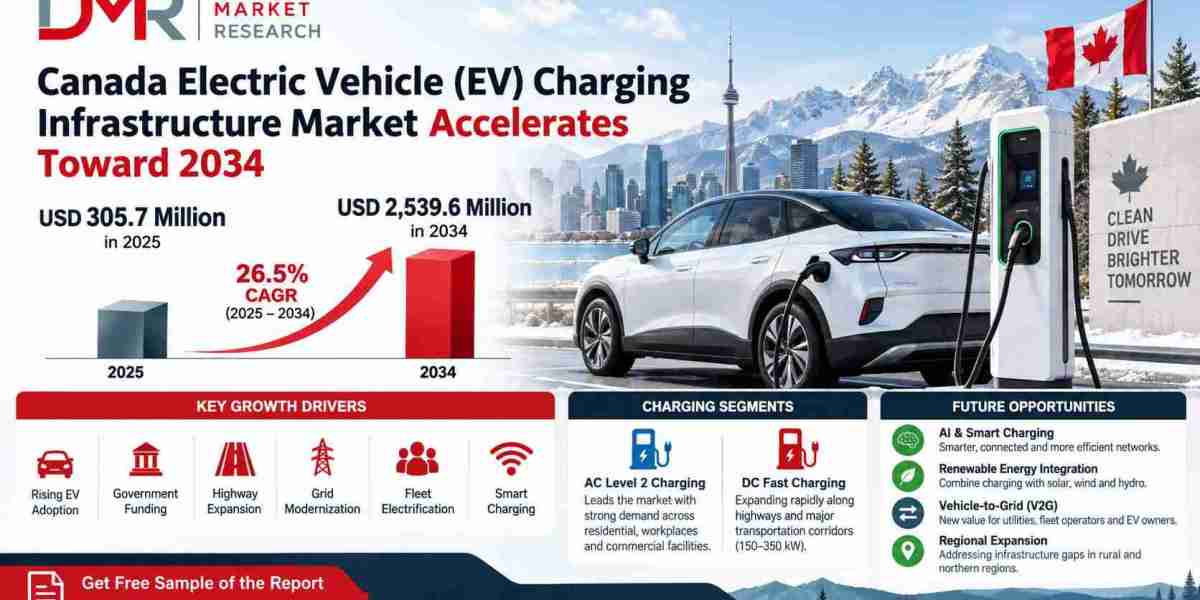
The Canada EV Charging Infrastructure Sector is entering a rapid expansion phase, with market value expected to increase from USD 305.7 million in 2025 to USD 2,539.6 million by 2034, representing a 26.5% CAGR from 2025 to 2034, according to Dimension Market Research. The market is being shaped by rising electric vehicle adoption, government funding, provincial electrification policies, infrastructure investment and growing demand for reliable public and private charging networks.
Canada is strengthening its EV ecosystem as automakers, utilities, charging network operators, municipalities and technology providers expand charging capacity. Federal initiatives, including the Zero-Emission Vehicle Infrastructure Program and clean-energy investment programs, are supporting the deployment of charging stations across urban centers, highways, workplaces, residential properties and fleet facilities.
Canada EV Charging Infrastructure Market Growth Drivers
The rapid expansion of Canada's electric vehicle fleet is creating sustained demand for charging infrastructure. Federal and provincial policies are encouraging EV adoption while investments in charging networks are helping address range concerns and improve consumer confidence.
Key growth factors include:
- EV adoption is increasing demand for accessible charging networks.
- Government funding is reducing infrastructure investment barriers.
- Highway corridors are seeing rapid deployment of DC fast chargers.
- Utilities are investing in grid modernization for EV electrification.
- Fleet operators are accelerating depot and workplace charging.
- Smart charging is improving energy and network management.
The Government of Canada has established a target for all new light-duty vehicle sales to be zero-emission vehicles by 2035. This long-term policy direction is expected to encourage additional investments across charging hardware, software, energy management and network operations.
Get free sample of the report - https://dimensionmarketresearch.com/request-sample/canada-ev-charging-infrastructure-market/
AC Charging Leads While DC Fast Charging Expands
AC Level 2 charging is expected to remain a major segment of the Canadian EV charging infrastructure market because of its suitability for residential properties, workplaces, commercial buildings and municipal facilities. Its relatively lower installation cost and compatibility with daily charging requirements make Level 2 infrastructure attractive to businesses and property owners.
At the same time, DC fast charging is expanding rapidly along major highways and interprovincial transportation corridors. High-power chargers ranging from approximately 150 kW to 350 kW can reduce charging times and support long-distance electric mobility.
This creates a complementary infrastructure model in Canada, with Level 2 chargers supporting longer-duration parking and daily charging while DC fast chargers address highway, fleet and rapid-turnaround requirements.
Smart Charging and AI Create New Market Opportunities
The Canadian charging ecosystem is moving beyond basic electricity delivery toward connected and intelligent energy infrastructure. IoT-enabled chargers, cloud platforms, Open Charge Point Protocol systems and artificial intelligence are improving network management.
AI-based charging platforms can forecast electricity demand, identify equipment problems, optimize charging schedules and balance loads against grid conditions. Predictive maintenance can also help operators identify potential equipment failures before they cause extended downtime.
Smart charging is particularly important as EV penetration increases. Dynamic energy management can shift charging toward periods of lower electricity demand or greater renewable-energy availability, helping businesses and utilities control operating costs.
Renewable Energy and V2G Strengthen Investment Potential
Canada's renewable electricity resources create opportunities to combine EV charging with solar, wind, hydroelectric generation and battery storage. Smart microgrids can support charging infrastructure while improving energy resilience and reducing dependence on conventional power sources.
Vehicle-to-Grid (V2G) technology represents another emerging opportunity. Bidirectional charging can allow compatible EVs to return stored electricity to the grid during periods of high demand. Although commercialization is still developing, V2G could create additional value for fleet operators, utilities and EV owners.
Competitive Landscape
The Canada EV charging infrastructure market features domestic charging providers, utilities, energy companies, technology firms and global infrastructure manufacturers. Competition is increasingly focused on charging speed, network reliability, interoperability, software capabilities, geographic coverage and total operating efficiency.
Prominent market participants include FLO, ChargePoint, Hydro-Québec's Electric Circuit, BC Hydro, Tesla, Shell Recharge, Petro-Canada, ABB, Siemens, Blink Charging, Electrify Canada, EVduty, Grizzl-E, Hypercharge Networks, Ivy Charging Network, Schneider Electric, SWTCH Energy, Wallbox and Webasto Group.
Strategic partnerships between utilities, automakers, charging operators, retailers and property owners are expected to remain important as companies seek to scale charging networks while improving accessibility.
Regional Expansion and Infrastructure Gaps
Ontario, Quebec and British Columbia remain important markets because of relatively strong EV adoption and established charging infrastructure. However, rural communities and northern regions continue to present infrastructure gaps.
The country's large geographic footprint creates both an investment challenge and an opportunity. Highway charging corridors, rural charging hubs, fleet depots and multi-unit residential charging can support broader EV adoption while opening new opportunities for infrastructure developers and technology providers.
Report Also Cover
What is the Canada Electric Vehicle Charging Infrastructure Market size?
The market is projected to grow from USD 305.7 million in 2025 to USD 2,539.6 million by 2034.
What is the Canada EV charging infrastructure market CAGR?
The market is expected to register a 26.5% CAGR during 2025 to 2034.
What is driving EV charging infrastructure growth in Canada?
EV adoption, government funding, electrification targets, charging demand and infrastructure investment are major growth drivers.
Which charging technology dominates Canada?
AC charging, particularly Level 2 infrastructure, is expected to remain highly important across residential, workplace and commercial applications.
Is DC fast charging growing in Canada?
Yes. DC fast charging is expanding along highways, urban corridors, fleet facilities and high-traffic locations.
What role does AI play in EV charging?
AI supports demand forecasting, predictive maintenance, dynamic charging, energy optimization and network management.
Which companies are active in Canada's EV charging market?
FLO, ChargePoint, Hydro-Québec, BC Hydro, Tesla, Shell Recharge, Petro-Canada and other global and Canadian providers participate in the market.
What are the major EV charging market opportunities?
Renewable-powered charging, smart charging, fleet electrification, highway charging and V2G represent important opportunities.
Which regions have strong EV charging potential?
Ontario, Quebec and British Columbia are leading markets, while rural and northern regions offer significant infrastructure expansion opportunities.
What does the Canada EV charging market report include?
The report covers market size, forecasts, trends, drivers, restraints, opportunities, charger types, connector types, deployment, charging levels, connectivity, applications and competitive analysis.
Strategic Outlook for Canada's EV Charging Infrastructure
The Canada EV Charging Infrastructure Sector is moving toward a more connected, high-power and digitally managed ecosystem. Growth in EV ownership, federal and provincial support, fleet electrification and highway charging requirements is expected to sustain infrastructure investment through 2034.
For businesses, investors and industry decision-makers, opportunities extend beyond charger deployment. Network software, energy management, renewable integration, fleet charging, grid services and V2G technologies could become increasingly important parts of the market value chain.
As Canada's transportation system transitions toward zero-emission mobility, reliable and scalable charging infrastructure will remain essential to supporting EV adoption and achieving national electrification objectives. The combination of policy support, technology development and private-sector investment positions the Canadian charging infrastructure industry for substantial long-term growth.
Related Report:
About Us
Dimension Market Research (DMR) is a global market intelligence and consulting firm delivering data-driven insights that help organizations make informed strategic decisions. With expertise across 12+ industries and global markets, DMR provides syndicated reports, custom research, competitive analysis, white space analysis, and business strategy consulting.
Our research solutions combine analytical rigor, industry expertise, and forward-looking intelligence to identify opportunities, reduce risks, and support sustainable growth. Trusted by clients across diverse sectors, DMR is committed to delivering accurate, actionable insights that enable businesses to navigate evolving market landscapes with confidence.
Contact Us
Phone USA: +17323699777
Phone India: +919310023843
E-mail: enquiry@dimensionmarketresearch.com
Address USA: 957 Route 33, Suite 12 #308, Hamilton Square, NJ-08690
Address India: D44, Sector 6, Noida 201301, India