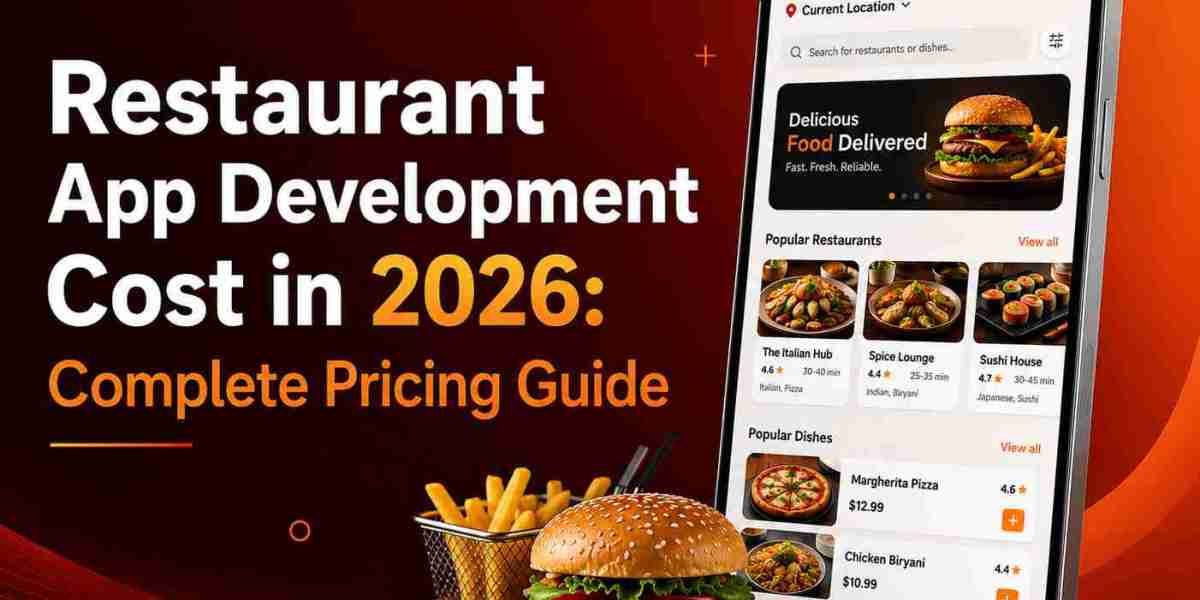

The restaurant industry has changed rapidly as customers increasingly use smartphones to discover restaurants, explore menus, place food orders, reserve tables, make payments, and track deliveries. For restaurant owners and food businesses, a mobile application can create a direct digital connection with customers while improving ordering and operational processes.
However, developing a restaurant application involves more than creating an attractive menu screen. The technology behind ordering, payments, restaurant management, delivery, notifications, customer accounts, and third-party integrations can significantly influence the overall investment. This is why understanding the restaurant app development cost is important before starting a project.
The final budget depends on the type of application, required features, technology, design complexity, integrations, development team, and long-term maintenance strategy.
Understanding Restaurant App Development Cost
The Cost of restaurant app development can vary widely because every restaurant business has different requirements. A simple application for a single restaurant may only need menu browsing, table reservations, ordering, and payments. A larger food delivery marketplace may require separate applications for customers, restaurants, delivery partners, and administrators.
The complexity of the backend also affects the budget. The system may need to manage menus, orders, inventory, restaurant locations, customer information, payments, promotions, delivery assignments, and real-time status updates.
Therefore, businesses should define their business model and required functionality before estimating the development budget.
What Type of Restaurant App Are You Building?
The first factor affecting development cost is the type of application.
A single-restaurant app is generally easier to develop because one business controls the menu, pricing, orders, and customer experience. It can focus on direct ordering, reservations, loyalty programs, and restaurant-specific promotions.
A multi-restaurant marketplace is more complex. Customers can discover different restaurants, while restaurant owners need separate dashboards to manage menus, orders, availability, and promotions. If delivery partners are involved, the platform may also require delivery management and real-time tracking.
A restaurant reservation application has another structure. Its primary functions may include restaurant discovery, table availability, reservations, reminders, and booking management rather than food delivery.
Choosing the right model at the beginning helps prevent unnecessary development work.
Essential Features of a Restaurant App
The features included in an application have a direct impact on the restaurant app development cost.
A customer-facing application usually begins with registration and profile management. Customers may be able to save delivery addresses, payment preferences, favorite restaurants, and previous orders.
A digital menu is another essential component. Users should be able to browse categories, view food images, read descriptions, check prices, and select available options or add-ons.
Search and filtering can help customers quickly find restaurants or dishes according to cuisine, price, location, ratings, dietary preferences, or availability.
The shopping cart and checkout process should be simple and transparent. Customers need to review their items, apply eligible discounts, select a delivery or pickup option, choose payment methods, and confirm their orders.
Order tracking can provide status updates as the restaurant accepts, prepares, and completes the order.
Restaurant Management Features
Restaurant owners need tools that allow them to manage their operations efficiently. A restaurant dashboard can provide control over menus, prices, food availability, operating hours, incoming orders, and promotions.
Restaurant staff may also need notifications whenever a new order is placed. The system can provide order status controls so customers receive updated information.
Analytics can help restaurant owners understand order volumes, popular menu items, revenue trends, and customer activity.
For larger businesses with multiple branches, the platform may need location-specific menus, inventory, pricing, staff access, and reporting. These additional requirements can increase the overall Cost of restaurant app development.
Online Ordering and Payment Integration
Online ordering is usually one of the central functions of a restaurant application. The application needs to communicate reliably with the backend so that customers can place orders and restaurants can receive them promptly.
Payment integration is another important consideration. Depending on the target market, businesses may support cards, digital wallets, bank-based payment methods, or cash on delivery.
Developers also need to account for failed payments, refunds, cancellations, transaction confirmations, and order reconciliation.
The number of payment options and complexity of transaction workflows can therefore influence the cost of developing a restaurant app.
Delivery and Real-Time Tracking
If the restaurant provides delivery, the development scope becomes broader. The platform may need a dedicated delivery interface through which delivery partners can receive assignments, view addresses, update order status, and communicate relevant information.
Location services can help determine delivery areas and provide customers with estimated delivery information. Real-time tracking may require maps, location APIs, route information, and continuous communication between different parts of the system.
For a multi-restaurant delivery marketplace, order assignment can become even more complicated because the platform needs to coordinate restaurants, customers, and delivery partners.
These capabilities can significantly increase development time compared with a simple restaurant ordering application.
Loyalty Programs and Customer Engagement
Restaurants often use mobile applications to encourage repeat purchases. Loyalty points, rewards, discount codes, referral programs, memberships, and personalized promotions can be integrated into the customer experience.
Push notifications can inform users about special offers, order updates, new menu items, and relevant promotions.
Personalization can also be introduced using customer behavior and purchase history. For example, the application may recommend dishes based on previous orders or highlight relevant offers.
Although these features can improve customer engagement, they add additional development and backend requirements.
UI/UX Design and User Experience
Design has a significant role in restaurant applications because food ordering should feel quick and visually appealing.
A well-designed interface can make it easier for customers to browse menus, understand customization options, and complete purchases. Food images, category navigation, product details, cart management, and checkout should work together naturally.
The design requirements become more complex when the application includes multiple user types. Customers, restaurant staff, delivery partners, and administrators may each require different interfaces.
Custom animations, advanced interactions, personalized layouts, and highly branded designs can also increase the development effort.
Backend, APIs, and Third-Party Integrations
The mobile application is only one part of the overall system. A restaurant platform needs backend infrastructure to manage users, menus, orders, payments, notifications, restaurants, delivery information, and other business data.
Third-party integrations can further influence development costs. A restaurant application may connect with payment gateways, maps, SMS services, push notification systems, analytics platforms, POS systems, accounting software, or inventory solutions.
Each integration needs development, testing, error handling, and ongoing maintenance. Businesses should identify essential integrations before development starts to create a more accurate estimate.
Security and Data Protection
Security should be considered from the beginning of the project. Restaurant applications can process customer names, phone numbers, addresses, order information, and payment-related data.
Secure authentication, encrypted communication, appropriate access controls, secure APIs, and responsible data storage can help protect users and business information.
Testing should also cover common security risks, account access, payment workflows, and administrative permissions.
Investing in security may increase initial development effort, but it can help reduce technical and operational risks as the platform grows.
How to Reduce the Cost of Developing a Restaurant App
Businesses do not necessarily need to launch every possible feature in the first version. A practical strategy is to develop an MVP containing the most important customer and restaurant workflows.
For example, the first version can focus on registration, menu browsing, cart management, ordering, payments, order status, and restaurant administration. Advanced loyalty systems, AI recommendations, sophisticated analytics, and additional integrations can be introduced later.
Clear requirements can also reduce unnecessary development changes. Before development begins, businesses should establish user roles, features, platforms, integrations, payment methods, and future expansion plans.
A phased development strategy allows businesses to validate the concept with real customers before making larger technology investments.
Choosing the Right Development Partner
The development team can influence both the quality and efficiency of the project. When evaluating a development partner, businesses should consider experience with mobile applications, backend systems, payment integrations, location services, APIs, cloud infrastructure, and security.
A reliable partner should also provide transparent communication about timelines, development milestones, testing, maintenance, and future updates.
Businesses should clarify source-code ownership, intellectual property, third-party services, hosting, maintenance responsibilities, and support arrangements before beginning the project.
Conclusion
The restaurant app development cost depends on the business model, application features, design, integrations, backend complexity, security requirements, development team, and long-term objectives. A simple application for one restaurant can have a very different scope from a complete food marketplace with restaurants, customers, delivery partners, and administrators.
Understanding the Cost of restaurant app development before development begins helps businesses prioritize the features that matter most. Starting with an MVP, selecting suitable technology, and planning future expansion can make the development process more manageable.
Ultimately, the cost of developing a restaurant app should be viewed as an investment in customer convenience, operational efficiency, and long-term digital growth. With the right strategy and development approach, a restaurant application can become much more than an online menu, it can become a complete digital channel for ordering, customer engagement, loyalty, and business expansion.