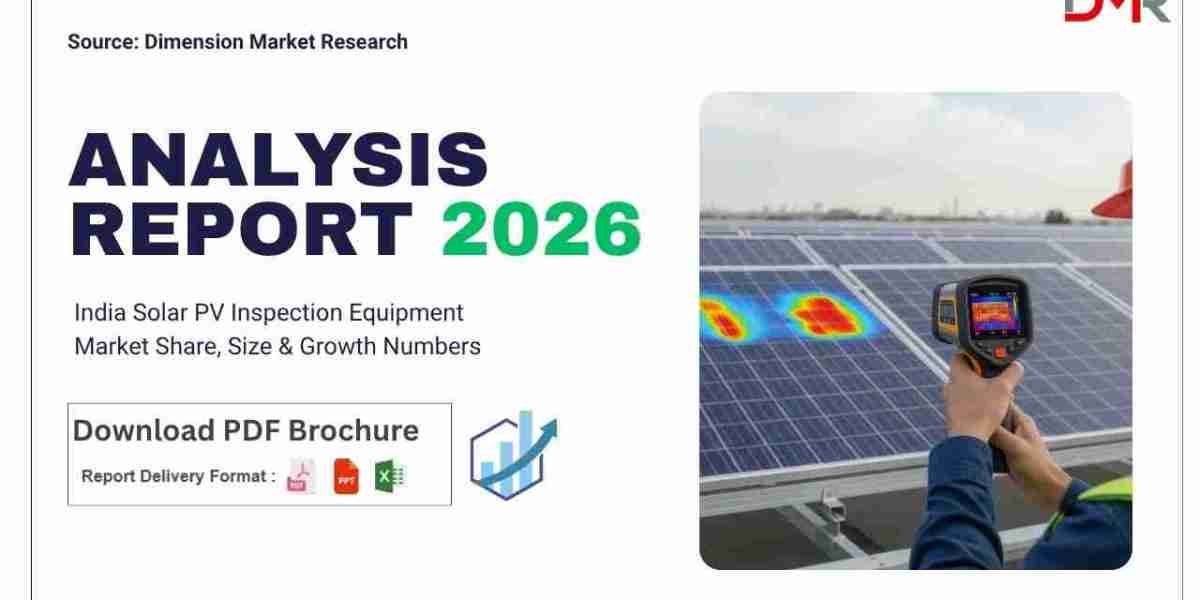

India Solar String Monitoring Equipment Industry to Reach USD 236.8 Mn by 2035
The India Solar String Monitoring Equipment Industry is entering a strong growth phase as India's expanding solar power infrastructure increases demand for granular, reliable and digitally connected photovoltaic monitoring. The market is estimated at USD 84.7 million in 2026 and is projected to reach USD 236.8 million by 2035, representing a 12.1% CAGR during the forecast period.
Solar string monitoring equipment combines hardware and software that measure and supervise the electrical performance of individual photovoltaic strings and associated DC circuits. These solutions can include string monitoring boxes, current and voltage sensing modules, data loggers, gateways, communication interfaces, fuse and surge-protection status monitoring, and SCADA integration.
Unlike inverter-level monitoring, string-level monitoring enables operators to identify problems affecting individual circuits. Open circuits, fuse failures, connector issues, mismatch, shading, insulation problems and underperforming strings can otherwise remain difficult to isolate when thousands of strings operate simultaneously.
India Solar String Monitoring Equipment Industry: Key Highlights
- 2026 market size: USD 84.7 million
- 2035 forecast value: USD 236.8 million
- Forecast CAGR: 12.1% from 2026–2035
- Leading equipment: String Monitoring Boxes, 38.6% share
- Leading parameter: String Current, 46.9% share
- Leading communication: RS485/Modbus, 51.7% share
- Leading application: Utility-scale solar, 57.8% share
- Fastest communication segment: LoRa/LPWAN at 18.1% CAGR
Get sample overview of the market - https://dimensionmarketresearch.com/request-sample/india-solar-string-monitoring-equipment-market/
Utility-Scale Solar Drives Market Expansion
Utility-scale solar plants represent the largest application segment, accounting for approximately 57.8% of 2026 revenue. Large photovoltaic facilities can contain thousands or even tens of thousands of strings, making manual troubleshooting increasingly inefficient.
String monitoring gives operators detailed performance information and supports faster fault localization. It can also help solar asset owners compare plant blocks, investigate energy losses, validate performance guarantees and prioritize maintenance activities.
India's expanding installed solar base is consequently creating a larger addressable market for monitoring equipment. Commercial and industrial solar projects are also increasing their use of granular monitoring as asset owners place greater emphasis on uptime, energy yield and operational transparency.
String Monitoring Boxes Lead Equipment Demand
String Monitoring Boxes are expected to remain the leading equipment category, representing around 38.6% of 2026 revenue. Their widespread deployment reflects established integration with DC combiner systems and plant SCADA architectures.
However, Data Loggers & Gateways are expected to experience particularly strong expansion, with a projected 15.8% CAGR from 2026 to 2035. Growing demand for remote monitoring and centralized plant-data management is supporting this development.
String Current is the leading monitoring parameter, accounting for approximately 46.9% of 2026 revenue. Current deviations can provide an important early indication of string-level underperformance. Meanwhile, Insulation Resistance is projected to grow at a 15.2% CAGR, highlighting increasing attention to electrical safety and fault detection.
RS485/Modbus Remains the Dominant Communication Technology
RS485/Modbus is estimated to account for approximately 51.7% of 2026 market revenue. Its established industrial footprint, affordability and compatibility with inverters, gateways, data loggers and SCADA platforms continue to support adoption.
At the same time, LoRa/LPWAN is projected to record an 18.1% CAGR through 2035. Wireless connectivity can reduce cabling requirements and create opportunities for distributed installations, retrofit projects and locations where conventional communication infrastructure is difficult to deploy.
AI and Digital O&M Create New Opportunities
Artificial intelligence is changing how operators interpret the large volumes of data generated by solar string monitoring systems. Machine-learning models can analyze abnormal current patterns, intermittent faults, mismatch, shading signatures, soiling effects and gradual degradation.
AI-based analytics can combine string measurements with irradiance, temperature, inverter output, weather and maintenance information to rank potential problems according to estimated energy loss or operational importance.
Generative AI can further support O&M teams by summarizing alarm histories, creating maintenance notes, retrieving relevant procedures and helping engineers interrogate large SCADA datasets. Human engineering oversight remains essential for electrical isolation, field intervention and safety-critical decisions.
Smart Combiner Boxes and 1500 V DC Systems Shape Technology
The market is increasingly moving toward smart combiner boxes that integrate current sensing, voltage measurement, fuse monitoring, surge-protection status, temperature inputs and communications within a single field device. This approach can reduce component count and simplify installation.
The continuing adoption of 1500 V DC PV architectures is also encouraging suppliers to develop higher-channel-density monitoring solutions with broader current ranges, stronger isolation and improved environmental protection.
Integration with SCADA, asset-performance-management platforms and digital O&M systems is becoming another important market trend. Instead of operating as standalone devices, string monitoring systems are increasingly becoming part of a connected solar asset-management ecosystem.
Market Restraints and Growth Opportunities
Additional hardware, communication infrastructure and SCADA integration can increase project costs. This is particularly relevant for smaller installations where inverter-level monitoring may be considered sufficient. Retrofit projects can also face enclosure-space, wiring and communication constraints.
Data quality represents another challenge. Incorrect channel mapping, sensor failures, communication noise and poor commissioning can produce false alarms or missing measurements.
Nevertheless, these challenges create opportunities for vendors offering integrated and easier-to-deploy solutions.
- Smart combiner boxes can reduce separate field components.
- Edge analytics can identify faults closer to the source.
- Wireless monitoring can improve retrofit economics.
- Cloud platforms can enable portfolio-level diagnostics.
- Higher-density devices can reduce enclosure requirements.
- Integrated gateways can simplify SCADA connectivity.
India Solar String Monitoring Equipment Industry Competitive Landscape
The competitive environment includes electrical-component manufacturers, industrial automation companies, instrumentation suppliers, inverter manufacturers, SCADA providers, solar EPC companies and specialist monitoring vendors. Competition is increasingly shifting from standalone sensing equipment toward integrated hardware, connectivity, analytics and long-term O&M solutions.
The market includes companies such as Phoenix Contact India, Weidmüller, Schneider Electric India, ABB India, Siemens, Socomec, Larsen & Toubro, Eaton, Mersen, Secure Meters, Rishabh Instruments, Advantech, Moxa, SMA Solar Technology, Sungrow, Huawei, Delta Electronics, Hitachi Energy, Waaree Energies, Tata Power Solar Systems and other industry participants.
Regulatory and Technology Outlook
India does not currently have a standalone regulatory framework dedicated exclusively to solar string monitoring equipment. Instead, market requirements are influenced by broader electrical safety, PV system design, grid connectivity, equipment conformity, surge protection, insulation and communication requirements.
Technology development is expected to focus on higher channel density, 1500 V DC compatibility, isolated sensing, smart field devices, edge processing, industrial communications and cloud integration. As solar portfolios become larger and more digitally managed, reliable string-level data is likely to become increasingly important for performance verification and O&M planning.
Overall, the India Solar String Monitoring Equipment Industry is positioned for sustained expansion through 2035. Rising utility-scale solar capacity, stronger focus on energy yield, smart combiner-box adoption, digital O&M and advanced communication technologies are expected to create new opportunities for equipment manufacturers and technology providers.
FAQ's
- What is the India Solar String Monitoring Equipment Industry?
It is the market for hardware and software used to monitor individual solar PV strings, DC circuits and related electrical parameters.
- What is the India Solar String Monitoring Equipment Industry size in 2026?
The market is estimated to reach USD 84.7 million in 2026.
- What will the market size be by 2035?
The market is projected to reach approximately USD 236.8 million by 2035.
- What is the CAGR of the India Solar String Monitoring Equipment Industry?
The market is projected to grow at a 12.1% CAGR from 2026 to 2035.
- Which equipment type leads the Indian market?
String Monitoring Boxes lead the equipment type segment with approximately 38.6% of 2026 revenue.
- Which monitoring parameter has the largest market share?
String Current leads the monitoring parameter segment with approximately 46.9% of 2026 revenue.
- Which communication technology dominates the market?
RS485/Modbus is the leading communication technology, accounting for approximately 51.7% of 2026 revenue.
- Which application dominates the market?
Utility-Scale Solar Plants lead the application segment with approximately 57.8% of 2026 revenue.
- How is AI transforming solar string monitoring?
AI helps identify abnormal patterns, prioritize faults, reduce false alarms and support predictive O&M decisions.
- What are the major opportunities in this market?
Smart combiner boxes, wireless monitoring, edge analytics, SCADA integration and high-density 1500 V DC solutions represent key opportunities.
Browse More Report:
About Us
Dimension Market Research (DMR) is a global market intelligence and consulting firm delivering data-driven insights that help organizations make informed strategic decisions. With expertise across 12+ industries and global markets, DMR provides syndicated reports, custom research, competitive analysis, white space analysis, and business strategy consulting.
Our research solutions combine analytical rigor, industry expertise, and forward-looking intelligence to identify opportunities, reduce risks, and support sustainable growth. Trusted by clients across diverse sectors, DMR is committed to delivering accurate, actionable insights that enable businesses to navigate evolving market landscapes with confidence.
Contact Us
Phone USA: +17323699777
Phone India: +919310023843
E-mail: enquiry@dimensionmarketresearch.com
Address USA: 957 Route 33, Suite 12 #308, Hamilton Square, NJ-08690
Address India: D44, Sector 6, Noida 201301, India