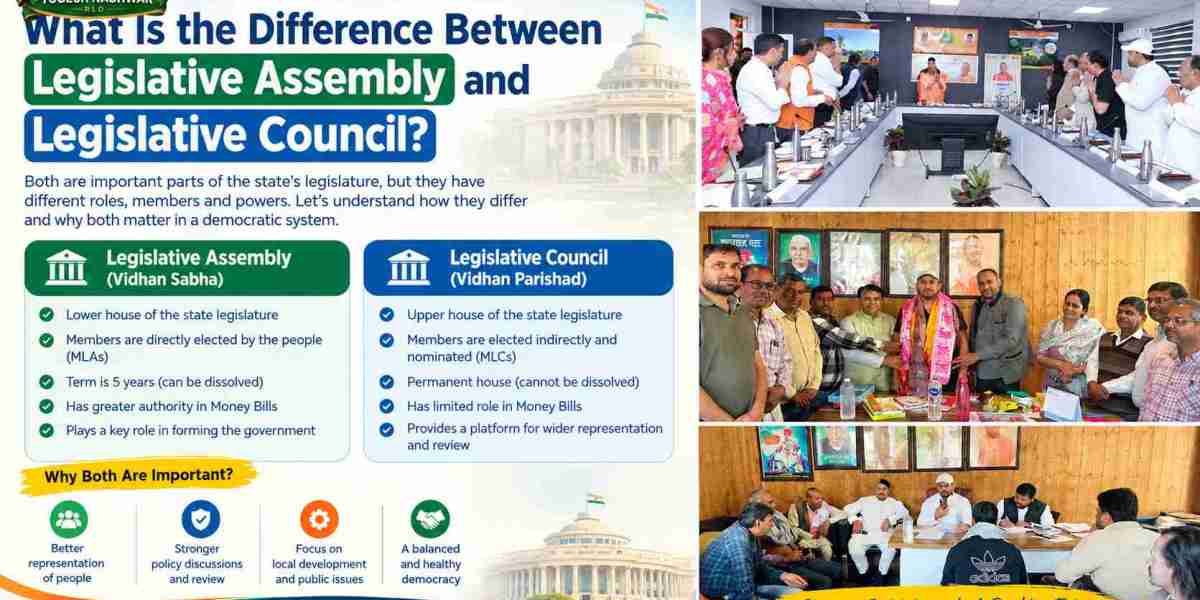

India has a parliamentary system in which states also have their own legislatures. Depending on the state, the legislature can have one house or two houses. The Legislative Assembly (Vidhan Sabha) is the main elected house in every state, while the Legislative Council (Vidhan Parishad) exists only in some states.
Although both bodies participate in law-making and discuss important public issues, their composition, elections, powers, and functions are different. Understanding this difference helps citizens better understand how state governments work and how public representatives contribute to governance.
What Is a Legislative Assembly?
The Legislative Assembly, commonly called the Vidhan Sabha, is the lower house of a state's legislature. Its members are directly elected by voters from different constituencies.
People vote for candidates during state elections, and the elected representatives become Members of the Legislative Assembly (MLAs).
The Legislative Assembly plays an important role in:
- Making and passing state laws
- Discussing public issues
- Approving the state budget
- Holding the state government accountable
- Raising concerns related to citizens and local development
- Discussing policies affecting education, agriculture, health, infrastructure, and employment
The political party or coalition that has the majority in the Assembly generally forms the state government, with its leader serving as the Chief Minister.
What Is a Legislative Council?
The Legislative Council, or Vidhan Parishad, is the upper house of a state legislature. Unlike the Legislative Assembly, it does not exist in every Indian state.
Under the Constitution, a state can have a Legislative Council if the required constitutional process is followed. Members of the Council are elected through different groups, including elected representatives of local authorities, MLAs, graduates, teachers, and other members nominated by the Governor.
Members of the Legislative Council are called Members of the Legislative Council (MLCs).
The Council provides another platform for discussing legislation, governance, and public concerns. Because its membership includes representatives elected through different constituencies and nominated members, it can bring a broader range of experience and viewpoints into the legislative process.
Legislative Assembly vs Legislative Council: Key Differences
The easiest way to understand the difference is to compare their main features:
| Feature | Legislative Assembly | Legislative Council |
|---|---|---|
| Common name | Vidhan Sabha | Vidhan Parishad |
| House | Lower House | Upper House |
| Members | MLAs | MLCs |
| Election | Directly elected by voters | Indirect election and nominations |
| Term | Normally 5 years | Permanent House |
| Dissolution | Can be dissolved | Cannot be dissolved as a whole |
| Minimum age | 25 years | 30 years |
| Government formation | Major role | Does not determine government formation |
| Money Bills | Greater authority | Limited role |
| Availability | Exists in every state | Exists only in some states |
How Are Members Elected?
One of the biggest differences is the method of election.
Assembly members are directly elected by citizens. Each constituency chooses its representative through state elections. This gives the Assembly a direct connection with voters.
Council members, on the other hand, are elected by different electoral groups. Some are elected by local authorities, some by MLAs, and others by graduates and teachers. A portion of Council members can also be nominated by the Governor from fields such as literature, science, art, cooperative movements, and social service.
This different system allows the Council to include people with varied professional and social experience.
Why Is the Legislative Council Important?
A Legislative Council can act as a reviewing chamber. Bills passed by the Assembly can be discussed and reconsidered in the Council.
The Council can:
- Debate proposed legislation
- Suggest improvements
- Raise public concerns
- Provide experienced perspectives
- Question government policies
- Participate in discussions on state administration
However, its powers are not equal to those of the Assembly in every area. This is particularly important for Money Bills, where the Assembly has the stronger constitutional position.
Role of an MLC in State Governance
An MLC can contribute to state governance by bringing public issues before the Legislative Council and participating in legislative discussions.
For example, an MLC may raise matters concerning:
- Farmers and agriculture
- Rural development
- Youth opportunities
- Education
- Roads and infrastructure
- Employment
- Public welfare
- Local community needs
For a public representative working in areas such as Mathura and Mant, legislative participation can provide an important platform for highlighting regional development priorities. Discussions around the key Achievement of Mant Yogesh Nauhwar can also be viewed in the broader context of public representation, development priorities, and issues raised for local communities.
Why Do Some States Have Two Houses?
A two-house legislature is designed to provide an additional level of discussion and review. The Assembly represents citizens through direct elections, while the Council brings together representatives selected through different methods.
The idea is that legislation can receive another level of examination before becoming law. Supporters see this as useful for improving the quality of legislation, while critics sometimes argue that an additional chamber can make the legislative process slower.
Both perspectives are part of the wider debate about how states should structure their legislatures.
Conclusion
The Legislative Assembly and Legislative Council have different roles, but both are connected to the functioning of state democracy. The Assembly is directly elected by citizens and has greater authority in areas such as government formation and Money Bills. The Council is a permanent upper house that provides an additional forum for debate, review, and representation.
Understanding the difference between MLAs and MLCs, as well as between the Vidhan Sabha and Vidhan Parishad, helps citizens understand how laws are discussed and how their representatives participate in state governance. Ultimately, both institutions are important parts of India's democratic system, with their effectiveness depending on meaningful debate, accountability, and attention to public concerns.