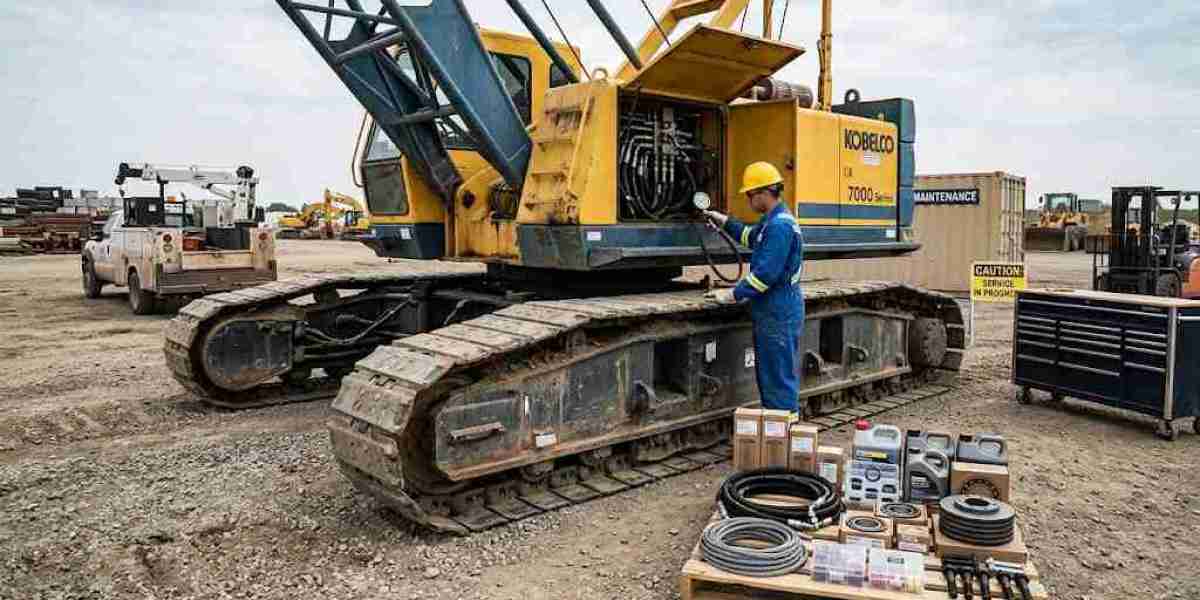

There is no gentle way to put it — when a Kobelco 7000 series crawler crane stops working on an active project, everything around it stops too. The lifting plan stalls. Supporting crews lose their work windows. Deadlines that were already tight become impossible. The machine's reputation as a reliable powerhouse only matters when it is running. Keeping it that way falls to the people responsible for its care.
Most unplanned shutdowns on heavy cranes trace back to a common root cause. Something wore out, someone noticed too late, and the replacement was not sitting on a shelf nearby. The fix for that pattern is straightforward in concept and demanding in execution: stock what you need before you need it. That means maintaining an inventory of essential Kobelco parts at the job site, not just at a distant distribution center.
Emergency shipping is an unreliable safety net. Freight gets rerouted. Components sit in customs holding areas. A warehouse runs out of stock on the exact part you require. Any one of these events turns a minor repair into a prolonged outage. Proactive stocking puts the repair timeline under your control instead of surrendering it to logistics.
What follows covers the major systems of the 7000 series and highlights the specific components that deserve a permanent place in your parts room.
Hydraulic Fluid Cleanliness and Filter Management
Every mechanical action on the 7000 series — boom hoisting, winch operation, track travel — is powered by pressurized hydraulic oil. That oil must remain clean to protect the精密内部 surfaces of pumps, valves, and cylinders. Filters perform this protective function, but only when they are fresh and properly installed.
Build a standing supply of hydraulic filters, engine oil filters, and fuel filters. Replace each one on schedule, regardless of how busy the job site becomes. Operating near loose earth, demolition dust, or fine aggregate accelerates filter loading well beyond what the standard intervals assume. The relatively small cost of an extra filter change is insignificant compared to the expense of replacing a damaged hydraulic pump.
Keep reserve quantities of the manufacturer-specified hydraulic oil at the site. Cylinder rod seals and fitting connections produce minor seepage during normal operation. Having the correct fluid available ensures that any top-off is done with the right product, avoiding the risk of mixing incompatible oil types under operational pressure.
Flexible Hose Assemblies and Connection Fittings
Within the hydraulic circuit, flexible hoses route pressurized fluid to every actuator on the crane. They flex as the boom moves, vibrate with engine operation, and rub against steel structural members. Temperature swings in summer and winter further stress the rubber and fabric layers. Each hose operates on a finite lifespan regardless of visual appearance.
A failed hose releases fluid abruptly and disables the function it serves. Temporary field repairs — clamps, sleeves, or tape — may provide limited restoration of operation. Only a correct replacement assembly with proper pressure ratings and end fittings provides a lasting solution.
Inspect every accessible hose on the machine periodically and note which ones show deterioration. Boom circuits, slewing feeds, and travel motor lines tend to experience the most punishment. Procure replacement assemblies for those vulnerable runs before they fail. Having these Kobelco parts on site lets you complete a hose replacement in under an hour, whereas waiting for an emergency order can consume days. Assemble a labeled kit of compatible fittings, O-rings, and adapters so that every connection point can be properly sealed during the repair.
Hydraulic Cylinder Seal Rebuild Kits
The cylinders that lift the boom, engage the brakes, and drive auxiliary movements on the 7000 series rely on internal seals to maintain hydraulic pressure. These rubber components gradually lose their flexibility over thousands of operating hours. When seals degrade, fluid bypasses the piston and the cylinder loses its ability to hold position.
The first indication is often subtle — a boom section that creeps downward when stationary, or a thin line of oil appearing on a cylinder rod during operation. Without deliberate inspection, these symptoms can go unnoticed for extended periods.
Rebuild kits supply every seal, o-ring, and backup ring needed to restore cylinder performance at a cost that is modest relative to a complete replacement. Always order kits designed specifically for the 7000 series. Generic seals of approximate dimensions cannot withstand the operating pressures these cylinders generate. Properly engineered Kobelco parts deliver a reliable seal from the first pressurization. Protect stored seal kits from heat and direct sunlight. Elastomer compounds degrade under prolonged UV and thermal exposure, meaning unused seals may fail during installation if they have been stored improperly.
Wire Rope and Rigging Component Supplies
The wire rope is the sole structural connection between the crane and every suspended load. It endures continuous tensile stress, surface abrasion over sheave grooves, and weather exposure. A thorough visual inspection before any lifting operation is a non-negotiable safety requirement.
Check each accessible section for broken wires, kinking, corrosion, flattening, or birdcaging. Once any portion of the rope reaches the discard threshold mandated by your applicable standards, the entire length must be retired immediately.
Maintain a complete spare spool of the correct diameter and construction at your storage location. Wedge sockets, rope clips, and dead-end hardware — the essential crane parts for securing the rope to the drum — should accompany the spool. Without this accompanying hardware, a rope replacement stalls regardless of your intentions. Evaluate the hook block sheaves at the same time. Rough or seized bearings inside the block will abrade new rope rapidly. Replace any suspect bearings as a standard part of the rope change procedure.
Crawler Track and Undercarriage Wear Items
The track assemblies supporting a 7000 series crane distribute its massive operating weight across the ground surface. Track shoes, connecting pins, bushings, idlers, and rollers all experience steady wear under these forces. The progression is so gradual that it rarely commands attention until a component actually fails.
Stock spare track shoes and fastener bolts as standard inventory items. Check track tension weekly using the measurement parameters outlined in the service manual. Loosely tensioned tracks risk derailing during travel, while over-tightened tracks waste fuel and place excess loads on drive components.
Listen for any new noise around the lower roller assemblies — grinding, clicking, or squealing that was not present during previous operations. A roller that seizes will gouge into the track chain, potentially damaging the entire assembly. Replacing a failing roller early is always cheaper than rebuilding a complete track system. Treat these undercarriage crane parts as essential inventory rather than emergency-only purchases.
Electrical Sensors and Safety Switches
The 7000 series employs electronic systems that monitor load capacity, boom geometry, and operational boundaries continuously. Load moment indicators, anti-two-block devices, and boom angle sensors feed critical data to the operator. When these instruments fail or lose calibration, the crane enters lockout mode and halts all lifting operations.
Moisture intrusion, connector corrosion, and vibration-related loosening are the leading causes of electrical failure on these machines. Wiring that contacts sharp structural edges during boom operation gradually loses insulation until a short circuit develops.
Carry replacement limit switches for hoist and boom functions as standard parts. Stock the fuse types and relay modules referenced in your electrical diagrams. During every inspection, examine visible wiring harnesses for signs of chafing or exposed conductors. Repair any damaged wiring during the same maintenance session rather than deferring the work. A neglected electrical defect tends to escalate into a failure that disables multiple systems simultaneously.
Brake Friction Discs and Bands
The braking mechanism on the 7000 series is responsible for holding massive loads in a suspended position. Brake bands and friction discs provide the clamping force that resists drum rotation. As the friction material thins, holding capacity drops and the potential for brake creep increases.
Routine adjustment can compensate for moderate wear over time. Each friction component, however, has a defined minimum thickness. Once material falls below that specification, replacement becomes the only safe course of action.
Keep a complete set of friction discs for the primary hoist and replacement brake bands for auxiliary winch functions. Measure remaining material thickness during each scheduled maintenance visit. If any component is approaching its minimum, execute the replacement during that maintenance window. Deferred brake maintenance creates a safety hazard with no acceptable workaround.
Battery Performance and Power Connections
The diesel engine in a 7000 series demands significant cranking current to start. Batteries that perform well during warmer months often reveal hidden weakness when temperatures decline. A battery that cannot deliver adequate amperage on a cold morning will halt the day's work before it begins.
Maintain a backup battery on a maintenance charger at your shop or site trailer. Replacement cables, terminal lugs, and protective boot covers should be stocked as regular consumables.
Corrosion accumulates on battery terminals and creates resistance that reduces available cranking current. Inspect and clean all connections during every maintenance visit. Degraded cables should be replaced rather than cleaned and reused. Poor connections also introduce voltage instability that triggers false error codes in the crane's control computers, diverting maintenance hours into unproductive diagnostic work.
Organizing Your Parts Room for Efficiency
Having the right components on hand is only half the equation. You also need to find them quickly and be confident they are still usable. Assign a clean, dry, and clearly labeled storage area near the crane exclusively for spare components. Every shelf and container should display its contents visibly.
Use a rotation method where newly acquired items are placed behind older stock. This keeps shelf-life-sensitive materials — oil filters, rubber seals, chemical products — moving through the inventory before their properties degrade.
Record every part you install during maintenance activities. When replacement rates for a particular item increase beyond expected levels, that trend often signals a mechanical issue worth investigating. Data-driven parts management converts a simple storage exercise into a diagnostic advantage.
Summary
Servicing a Kobelco 7000 series crawler crane is a discipline rooted in preparation and attention to detail. Each system described above has predictable wear patterns and known vulnerable components. The diffaerence between a productive season and a costly series of breakdowns often comes down to what is sitting on your parts shelf.
An organized collection of essential crane parts keeps your equipment operating, your crews working, and your project schedules intact. Spend one hour this week comparing your current inventory against the items outlined in this guide. Order what is missing now, before an avoidable failure forces the issue on someone else's timeline.