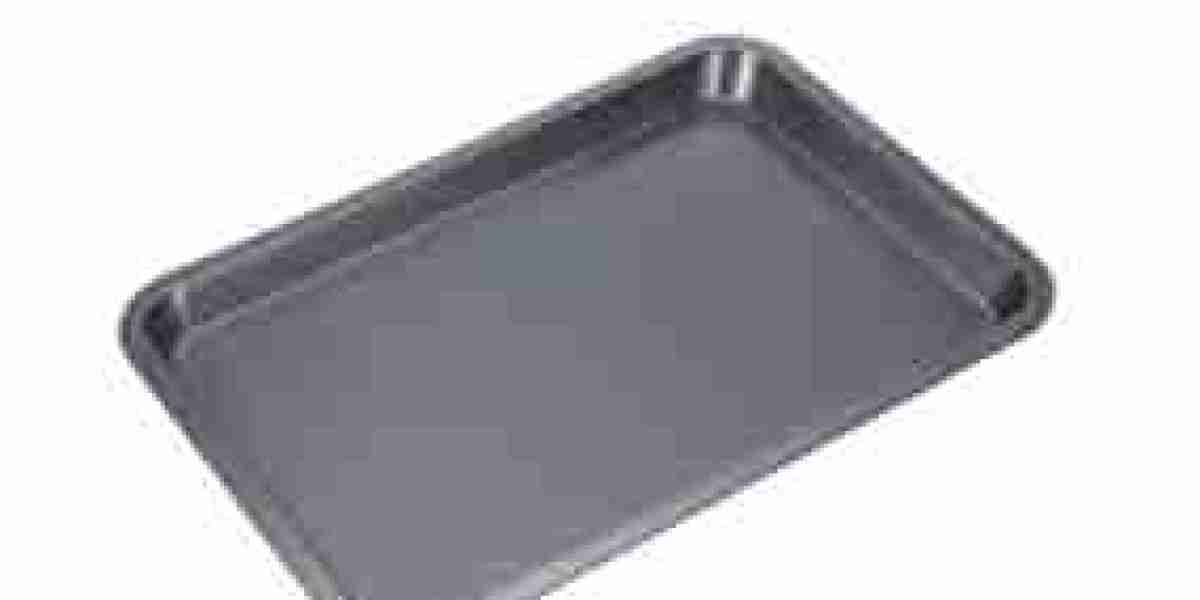

A Cookie Sheet And Roaster Pan needs to withstand repeated heating and cooling without losing its shape or surface finish. Although both products may use similar metal and coating systems, their different depths and cooking applications place different demands on the construction.
The base metal is one of the first details worth checking. Thinner steel can respond quickly to oven heat but may be more susceptible to deformation during repeated temperature changes. Heavier-gauge material generally provides greater structural stability, which can be useful for larger roasting pans carrying heavier food loads. The choice therefore needs to match the intended use rather than simply focusing on material thickness.
Coating adhesion is another important part of everyday performance. A non-stick surface may look smooth during a visual inspection but still have weak bonding underneath. Proper surface preparation, controlled coating thickness, and accurate curing temperatures all contribute to how well the coating remains attached during repeated cooking and cleaning. Batch sampling with adhesion tests can reveal problems that a visual inspection alone may miss.
Edge construction also affects long-term usability. A rolled or folded rim gives a flat baking sheet additional rigidity and helps reduce deformation when the metal expands inside a hot oven. This becomes increasingly important as pan dimensions grow because larger surfaces experience greater thermal movement.
The difference between a shallow cookie sheet and a deeper roasting pan also affects how buyers should evaluate the product. A shallow design is convenient for cookies, pastries, and other flat foods, while a deeper pan provides more space for roasts, casseroles, and foods that release liquid during cooking. Treating the two formats as identical simply because they share a coating system can overlook these practical differences.
For bulk orders, buyers may also need to consider packaging. Larger pans require more space and can create inefficient carton arrangements if the nesting depth has not been considered during product development. Confirming dimensions, stacking methods, and protective packaging before production can make transportation and warehouse handling easier.
Food-contact compliance should be checked according to the destination market as well. Coating materials, base metals, and production processes may require relevant testing or documentation before the products enter retail distribution.
Ultimately, the performance of a Cookie Sheet And Roaster Pan depends on several connected details rather than the non-stick coating alone. Stable material selection, proper coating adhesion, reinforced edges, and consistent production checks all contribute to whether the pan continues to perform after repeated use. For distributors placing repeat orders, maintaining these specifications from one batch to another can be just as important as the initial product design.