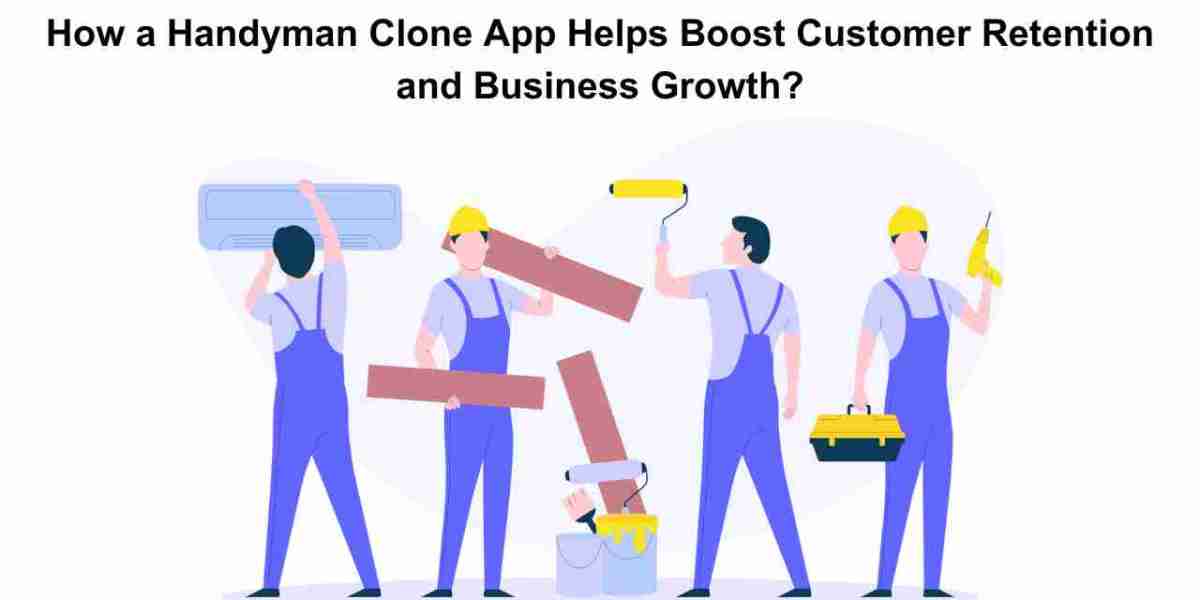

The demand for convenient home services is growing across cities and countries as customers look for faster and more reliable ways to handle repairs, maintenance, cleaning, installation, and other household tasks. Instead of spending time searching for service providers, comparing availability, making calls, and waiting for responses, customers increasingly prefer digital platforms that connect them with suitable professionals in a few simple steps.
For entrepreneurs and startups, this shift creates an opportunity to build a scalable service marketplace. A Handyman Clone App provides a ready business model inspired by successful on-demand platforms while allowing businesses to create their own brand, service categories, customer experience, and operating strategy.
However, launching an app is not enough to build a sustainable business. Customer retention is equally important. If customers use a platform once and never return, the business has to continuously spend effort attracting new users. A well-planned Handyman App Like Uber can improve the customer journey, encourage repeat bookings, simplify service discovery, and create a consistent experience that keeps users engaged.
This article explains how a Handyman Clone App can support customer retention and business growth, which features matter most, how entrepreneurs can structure their service marketplace, and why the model can work across different markets.
Why Customer Retention Matters for Handyman Businesses
Customer acquisition gets a business noticed, but customer retention helps it grow.
Home services are naturally suited to repeat usage. A customer may need a plumber today, an electrician next month, an appliance technician later, and a cleaner or painter at another time. If a service platform provides a reliable experience across these requirements, the same customer can become a long-term user.
Traditional local handyman businesses often depend on phone calls, personal contacts, referrals, or local advertising. While these channels can work, they may make it difficult to provide a consistent booking experience.
An On-Demand Handyman Services App can bring these activities into one convenient digital experience. Customers can discover services, select a suitable category, request assistance, follow booking updates, communicate with professionals, and manage their service history from one place.
The result is more than convenience. It creates repeated touchpoints between the customer and the business.
How a Handyman Clone App Supports Customer Retention
A successful service marketplace needs to make every repeat interaction easier than the previous one. The following capabilities can help achieve that goal.
Simple Service Discovery
Customers should not have to search through complicated menus to find the service they need.
A clear service structure can separate categories such as plumbing, electrical repairs, carpentry, appliance repair, painting, cleaning, installation, moving assistance, and general maintenance.
When customers can quickly identify the right service, they are more likely to complete their booking.
A Handyman App Like Uber can organize these categories in a familiar marketplace format, helping users find relevant services without unnecessary steps.
Faster Booking Experience
Convenience is one of the biggest reasons customers use on-demand platforms.
A customer dealing with a leaking tap or broken appliance may not want to spend an hour contacting different professionals. A digital booking process can reduce this friction by allowing users to select a service, enter the required details, choose a suitable time, and request assistance.
The easier the booking process becomes, the stronger the possibility of repeat usage.
Real-Time Service Updates
Customers want to know what is happening after they place a request.
Updates about booking confirmation, professional assignment, arrival status, and service progress can make the experience more transparent.
For urgent requirements, such as plumbing or electrical issues, visibility can be particularly valuable. Customers do not have to repeatedly call the service provider to ask when help will arrive.
This type of transparency can increase trust, which is one of the strongest foundations of customer retention.
Professional Profiles and Ratings
Trust plays a major role when customers invite service professionals into their homes.
A marketplace can allow customers to view relevant information about service providers, including ratings, reviews, completed services, and available service categories.
Reviews also help customers make informed decisions before booking.
For the business, this creates a feedback mechanism. Consistently positive service experiences can strengthen the platform's reputation and encourage customers to return.
Multiple Service Categories
A major advantage of an on-demand marketplace is that it does not have to depend on a single service.
A customer who initially joins the platform for a handyman plumber may later need electrical repair, furniture assembly, appliance maintenance, or painting.
By offering several categories through the same platform, a business can increase customer lifetime value.
This is one reason the Uber for Home Services model has attracted attention from entrepreneurs. The underlying concept is simple: create a convenient digital marketplace where customers can request different household services through one trusted platform.
Building a Stronger Customer Experience With Handyman App Like Uber
A Handyman App Like Uber can borrow proven marketplace principles from ride-hailing platforms and adapt them to home services.
The key is not to copy another company's branding or exact implementation. Instead, entrepreneurs can apply familiar concepts such as easy discovery, location-based matching, service tracking, ratings, notifications, and digital payments to their own business model.
Location-Based Service Matching
Location can be important for home services because customers usually want professionals who can reach them quickly.
A location-based matching system can help identify suitable professionals within a relevant service area.
For example, someone searching for a handyman near me app may expect to see professionals who actually serve their location rather than a list of providers operating several cities away.
Better matching can reduce waiting times and improve service availability.
Scheduled and Instant Services
Not every home service is urgent.
A broken water pipe may require immediate assistance, while furniture installation or painting may be scheduled several days in advance.
Supporting both instant and scheduled requests allows businesses to serve different customer needs.
This flexibility can also increase repeat usage because customers can rely on the same platform for both emergencies and planned home maintenance services.
Personalized Recommendations
Customer activity can provide useful insights into service preferences.
If a user frequently books cleaning services, the platform can make related services easier to discover. If another customer regularly requests appliance maintenance, relevant service categories can be highlighted.
Personalization should be helpful rather than intrusive.
Relevant recommendations can reduce the time customers spend searching and make the platform feel more convenient with every interaction.
Why Reliability Can Increase Repeat Bookings
Price is not the only factor that determines whether customers return to a service marketplace.
Reliability can be even more important.
Customers want professionals to arrive on time, complete the requested work properly, communicate clearly, and behave professionally.
A platform can support reliability by establishing service standards, collecting customer feedback, monitoring ratings, and maintaining clear provider profiles.
When users know what to expect, they are more likely to book again.
This is where an Uber for handyman business model can become valuable. The platform is not simply connecting customers and professionals. It is creating a structured experience around the service transaction.
Creating a Multi-Service Home Services Marketplace
Entrepreneurs do not necessarily need to limit their business to traditional handyman work.
The broader Uber For home services concept can include a range of household requirements.
Possible categories include:
- Plumbing and water-related repairs
- Electrical services
- Carpentry
- Appliance installation
- Appliance repair
- Painting
- Cleaning
- Furniture assembly
- Pest control
- Home improvement
- Moving assistance
- Gardening
- Air-conditioning maintenance
- General home maintenance services
A broader service portfolio gives customers more reasons to remain active on the platform.
For example, a customer might initially download the app to book an electrician. After having a positive experience, the same customer may return for plumbing, cleaning, or appliance repair.
This creates cross-service opportunities without requiring the customer to use multiple platforms.
Read More: Kickstart Your Handyman App like Uber: Feature & Cost
The Role of Convenience in Customer Loyalty
Modern customers have become accustomed to digital services that reduce effort.
They expect quick search, clear information, simple booking, timely notifications, and easy communication.
The same expectations are increasingly moving into the home services industry.
A traditional customer may search online for local handyman services, call multiple providers, wait for responses, and compare availability manually. A digital platform can simplify much of this process.
This convenience can become a competitive advantage.
When customers associate a platform with easy service discovery and dependable results, they have less reason to search for alternatives.
How Reviews and Feedback Improve Retention
Customer feedback should not be treated only as a rating displayed on a profile.
It can become an important tool for improving service quality.
After completing a booking, customers can provide ratings and reviews based on their experience. Businesses can analyze common complaints, identify high-performing professionals, and understand which parts of the service journey need improvement.
Positive reviews can also help new customers make decisions.
Over time, a strong review ecosystem can improve trust across the marketplace.
For startups entering a competitive market, this can be particularly valuable because customer confidence is often one of the biggest challenges during the early growth stage.
Notifications That Bring Customers Back
Notifications can support retention when they provide useful information.
Examples include:
- Booking confirmation
- Professional assignment
- Arrival updates
- Scheduled service reminders
- Booking completion
- Review requests
- Relevant service reminders
- Promotional announcements
- New service availability
The goal should not be to send unnecessary messages.
Useful notifications help customers stay informed without making the platform feel intrusive.
A well-designed Handyman App Like Uber can use notifications throughout the customer journey to improve communication and encourage future engagement.
Loyalty Strategies for Home Service Platforms
Customer retention can also be supported through loyalty programs and personalized offers.
For example, businesses may create benefits for repeat customers, referral programs, service bundles, seasonal maintenance reminders, or membership-style benefits.
A customer who regularly books home maintenance services may respond positively to a convenient maintenance package.
Similarly, referral programs can encourage existing customers to introduce new users to the platform.
The strategy should focus on creating genuine value rather than relying only on discounts.
How an On Demand Handyman App Can Support Business Growth
Customer retention and business growth are closely connected.
When customers return regularly, the platform can generate more transactions from its existing user base. This can improve marketplace activity and create more opportunities for service professionals.
At the same time, successful customer experiences can generate referrals and positive reviews, helping the business attract additional users.
An on demand handyman app can therefore create a cycle:
Customer discovers the platform → books a service → receives a good experience → returns for another service → recommends the platform → new customer joins.
The stronger this cycle becomes, the more sustainable the business can be.
Expanding Into New Locations
Once a business establishes demand in one market, it can consider expanding into additional cities or regions.
The marketplace model makes this possible because the same core business concept can be adapted to different service areas.
However, expansion should be based on local demand, provider availability, customer expectations, regulations, and service categories.
For example, a service that is highly popular in one region may have lower demand in another.
Entrepreneurs should therefore research each target market instead of assuming that one strategy will work everywhere.
How Handyman App Development Can Support Scalability
The long-term objective of handyman app development should be to create a service marketplace that can evolve as customer demand changes.
A startup may begin with a few core categories and expand after understanding its market.
For example, the initial business may focus on plumbing, electrical work, and cleaning. Once customer adoption grows, it can introduce appliance repair, carpentry, painting, installation, and other categories.
This gradual approach allows entrepreneurs to validate demand before expanding their operations.
It also gives the business more opportunities to increase customer engagement over time.
Why Businesses Are Exploring Uber for Handyman Services App Models
The popularity of on-demand platforms has changed customer expectations across multiple industries.
Customers already understand how marketplace applications work. They know how to search for a service, request assistance, receive updates, review providers, and complete transactions digitally.
This familiarity creates an advantage for entrepreneurs entering the home services market.
An Uber for Handyman Services App applies the same general convenience to household services.
Instead of building a customer journey around phone calls and manual coordination, the business can provide a digital marketplace that connects customers with service professionals.
The model can be especially attractive to startups looking for a proven business structure that can be customized for their target market.
Choosing the Right Handyman Script for Your Business
A handyman script can provide the foundation for launching an on-demand home services marketplace.
However, entrepreneurs should evaluate more than the number of features available.
The solution should support the business model, service categories, target market, customer journey, provider workflow, and future expansion plans.
Customization is important because every market has different customer expectations.
A business targeting residential customers in one country may need a different service structure from a company targeting commercial property managers or multiple cities.
The objective should be to create a platform that fits the business rather than forcing the business to fit a rigid application model.
Handyman App Like Uber for Startups and Entrepreneurs
Startups often need to validate their business idea quickly while maintaining room for future growth.
A Handyman App Like Uber can help entrepreneurs enter the market with a structured marketplace concept instead of starting every part of the business model from the ground up.
The entrepreneur can focus more attention on market research, customer acquisition, provider partnerships, service quality, and business development.
This approach can be useful for founders who already understand their target market but want to reduce the time required to establish their digital service platform.
The business can also evolve based on real customer feedback.
How to Compete With Local Handyman Businesses
Local providers remain important competitors because many customers already have trusted professionals.
A digital marketplace needs to provide a clear reason for customers to change their existing behavior.
Convenience is one option.
Customers may prefer a platform where they can compare providers, view ratings, request services, receive updates, and manage bookings from one place.
Reliability is another.
If the platform consistently delivers quality service, customers may gradually choose it instead of searching independently for individual professionals.
The goal is not simply to replace local providers. The marketplace can bring multiple local professionals together and make their services easier for customers to access.
Turning One-Time Users Into Repeat Customers
Customer retention begins with the first service experience.
A customer who receives a fast response, finds a suitable professional, gets clear updates, and receives satisfactory service has a stronger reason to return.
After the booking, the platform can maintain engagement through service history, recommendations, reminders, and relevant offers.
For example, customers may benefit from reminders for recurring home maintenance tasks.
Instead of waiting until something breaks, they can use the platform to schedule preventive maintenance.
This changes the relationship from occasional emergency booking to ongoing service usage.
Future Opportunities for Handyman Platforms
The home services industry continues to create opportunities for digital marketplaces.
Entrepreneurs can explore specialized verticals such as senior-friendly home assistance, commercial maintenance, property management services, appliance maintenance, smart home installation, renovation support, and recurring household services.
Artificial intelligence and automation can also improve areas such as service recommendations, customer support, provider matching, and demand forecasting.
However, technology should support the customer experience rather than become a feature simply for marketing purposes.
The most successful platforms will likely be those that combine useful technology with dependable human service.
Final Thoughts
A Handyman Clone App can give entrepreneurs a practical foundation for building a modern home services marketplace. Its value goes beyond allowing customers to book professionals online. When the platform makes service discovery easier, improves communication, supports reliable provider matching, encourages reviews, and creates opportunities for repeat bookings, it can contribute directly to customer retention.
The broader opportunity is to build a trusted destination for home requirements rather than a platform used only for occasional repairs. By combining multiple service categories, convenient booking, transparent communication, customer feedback, and personalized engagement, businesses can create stronger relationships with their users.
For startups and entrepreneurs targeting the growing on-demand services market, the Handyman App Like Uber model can provide a flexible path toward launching and expanding a digital home services business. The right strategy is to focus on local demand, service quality, customer trust, and continuous improvement rather than simply launching an application.
Choosing an experienced clone app development company can also help entrepreneurs turn the business concept into a market-ready solution that can evolve with changing customer and business requirements.
Frequently Asked Questions
1. What is a Handyman Clone App?
A Handyman Clone App is an on-demand service marketplace that connects customers with professionals who provide household and maintenance services. It can support services such as plumbing, electrical work, cleaning, carpentry, appliance repair, painting, and other home-related requirements.
2. How does a Handyman App Like Uber help customer retention?
A Handyman App Like Uber can improve retention by making service discovery, booking, communication, tracking, and feedback easier. When customers receive a consistent and convenient experience, they have more reasons to return to the same platform for future home services.
3. Can entrepreneurs offer multiple home services through one platform?
Yes. Entrepreneurs can create a multi-service marketplace that includes plumbing, electrical work, cleaning, carpentry, appliance repair, painting, installation, and other categories. Offering multiple services can encourage customers to use the same platform for different household requirements.
4. Why is customer feedback important for a handyman marketplace?
Customer feedback helps businesses understand service quality and identify areas that require improvement. Ratings and reviews can also help new users evaluate service professionals and build greater trust in the marketplace.
5. Is a Handyman Clone App suitable for startups?
Yes. A Handyman Clone App can be suitable for startups that want to enter the on-demand home services market with a structured marketplace model. Entrepreneurs can begin with selected service categories, understand customer demand, and expand their offerings as the business grows.