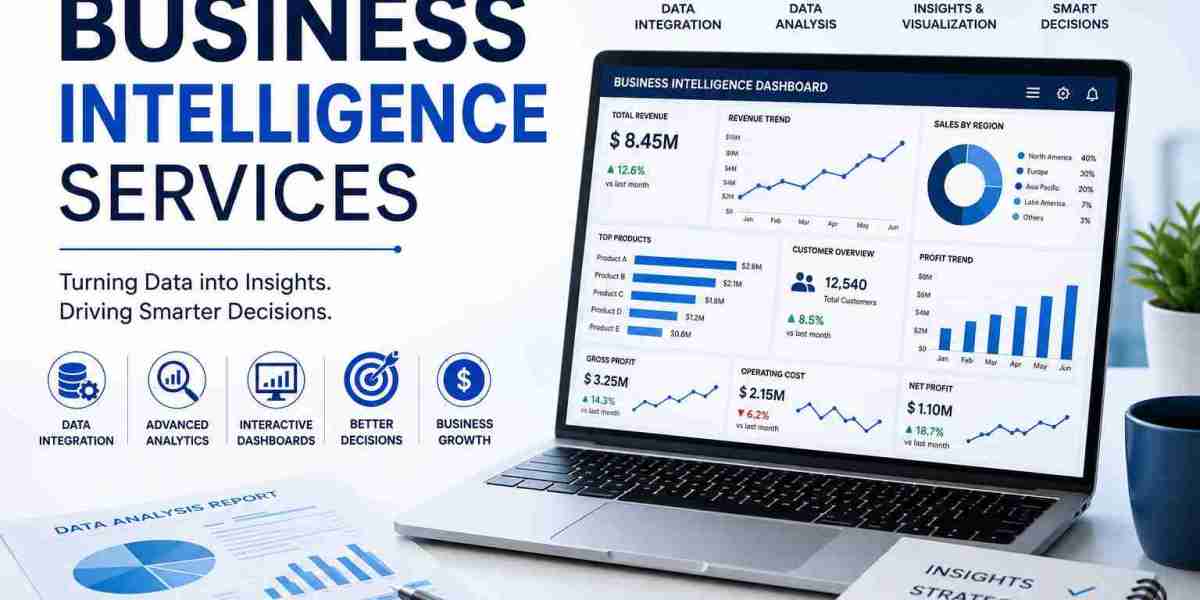

The Ultimate Guide to Leveraging Business Intelligence Services for Smarter Business Decisions
Introduction
Organizations generate more data today than ever before, yet many still struggle to transform that information into meaningful business outcomes. From customer behavior and operational performance to financial reporting, data often remains scattered across multiple systems, making it difficult to identify trends or make confident decisions.
This is where business intelligence services become invaluable. These services help businesses collect, organize, analyze, and visualize data so leaders can make informed, data-driven decisions instead of relying on assumptions. Whether you're a growing startup or an established enterprise, business intelligence provides the clarity needed to improve performance, reduce risks, and uncover new opportunities.
As organizations continue to embrace digital transformation, business intelligence (BI) has evolved from a reporting tool into a strategic capability that supports innovation, forecasting, and sustainable growth.
What Are Business Intelligence Services?
Business intelligence services are professional solutions that collect, integrate, analyze, and visualize business data to help organizations make faster, more informed decisions. They transform raw information into actionable insights through dashboards, reports, predictive models, and analytics tools.
Rather than simply presenting historical reports, modern BI solutions enable organizations to understand why events occurred, identify current trends, and anticipate future outcomes.
Core Components of Business Intelligence Services
Data Integration: Combine information from multiple business systems into a unified source.
Data Warehousing: Store structured data for efficient reporting and analysis.
Data Analytics: Discover patterns, trends, and relationships within datasets.
Data Visualization: Present insights through interactive dashboards, charts, and graphs.
Predictive Modeling: Forecast future trends using historical data and statistical techniques.
Performance Monitoring: Track key performance indicators (KPIs) in real time.
Self-Service BI: Enable business users to generate reports without technical expertise.
Together, these capabilities help organizations build a reliable foundation for smarter strategic and operational decisions.
How BI Services Transform Raw Data Into Actionable Insights
Business intelligence is more than collecting information—it's about creating a structured process that turns data into meaningful business value.
Step 1: Gather Data
Organizations collect information from various sources, including:
CRM platforms
ERP systems
Financial software
Marketing tools
Customer support systems
Website analytics
IoT devices
Step 2: Clean and Organize Data
Raw data often contains duplicates, inconsistencies, and missing values. BI professionals standardize and validate data to ensure accuracy before analysis.
Step 3: Analyze Business Performance
Using advanced data analytics, organizations identify:
Customer purchasing trends
Sales performance
Operational bottlenecks
Revenue opportunities
Cost-saving initiatives
Step 4: Visualize Insights
Interactive dashboards simplify complex information, allowing executives and managers to quickly interpret performance and monitor KPIs.
Step 5: Support Better Decisions
With reliable insights, organizations can confidently:
Optimize pricing strategies
Improve inventory management
Forecast demand
Allocate resources efficiently
Reduce operational risks
Key Benefits of Implementing BI in 2026 and Beyond
As markets become increasingly competitive, organizations need faster insights and greater agility. Business intelligence services play an essential role in achieving these objectives.
1. Faster Decision-Making
Real-time dashboards provide immediate visibility into business performance, enabling leaders to respond quickly to changing market conditions.
2. Improved Data Accuracy
A centralized data environment minimizes reporting errors and ensures everyone works from a single source of truth.
3. Better Customer Understanding
BI tools analyze customer behavior, purchasing habits, and engagement patterns to support personalized experiences and stronger customer retention.
4. Enhanced Operational Efficiency
Organizations can identify inefficiencies, automate reporting processes, and streamline workflows to reduce operational costs.
5. Stronger Financial Planning
Historical trends combined with predictive modeling help finance teams create more accurate budgets, revenue forecasts, and investment strategies.
6. Competitive Advantage
Businesses that consistently leverage data-driven decisions can respond more quickly to industry trends, customer expectations, and competitive threats.
7. Scalable Growth
As organizations expand, BI platforms scale with increasing data volumes while maintaining visibility across departments and business units.
Best Practices for Successful BI Implementation
Organizations achieve better results when business intelligence initiatives follow a structured approach.
Define Clear Business Objectives
Start by identifying the specific business problems BI should solve rather than implementing technology for its own sake.
Prioritize Data Quality
Reliable insights depend on clean, consistent, and well-governed data.
Focus on User Adoption
Provide intuitive dashboards and adequate training so employees can confidently use BI tools.
Measure Business Outcomes
Track KPIs that demonstrate the impact of BI initiatives, such as reporting speed, cost reduction, customer satisfaction, or revenue growth.
Continuously Improve
Business needs evolve over time. Regularly review dashboards, update metrics, and refine analytics models to maintain relevance.
Frequently Asked Questions
1. What are business intelligence services?
Business intelligence services help organizations collect, analyze, and visualize data for smarter decision-making. UnivDatos delivers scalable BI solutions tailored to business needs.
2. Can small businesses benefit from BI services?
Yes. UnivDatos provides flexible business intelligence services that help businesses of all sizes improve efficiency and make data-driven decisions.
3. Which industries use business intelligence services?
Healthcare, retail, finance, manufacturing, logistics, and e-commerce are among the many industries that benefit from UnivDatos' business intelligence services.
4. Why is data visualization important?
Data visualization simplifies complex data into easy-to-read dashboards and reports, helping businesses make faster and more informed decisions with UnivDatos.
Conclusion
Data has become one of the most valuable assets an organization possesses, but its true value lies in how effectively it is used. Business intelligence services enable organizations to transform scattered information into actionable insights that improve efficiency, strengthen forecasting, and support confident decision-making.
As digital transformation accelerates through 2026 and beyond, businesses that invest in data-driven strategies will be better positioned to adapt to market changes, uncover growth opportunities, and maintain a sustainable competitive advantage. Rather than viewing BI as simply a reporting function, organizations should recognize it as a strategic capability that empowers smarter decisions across every level of the business.