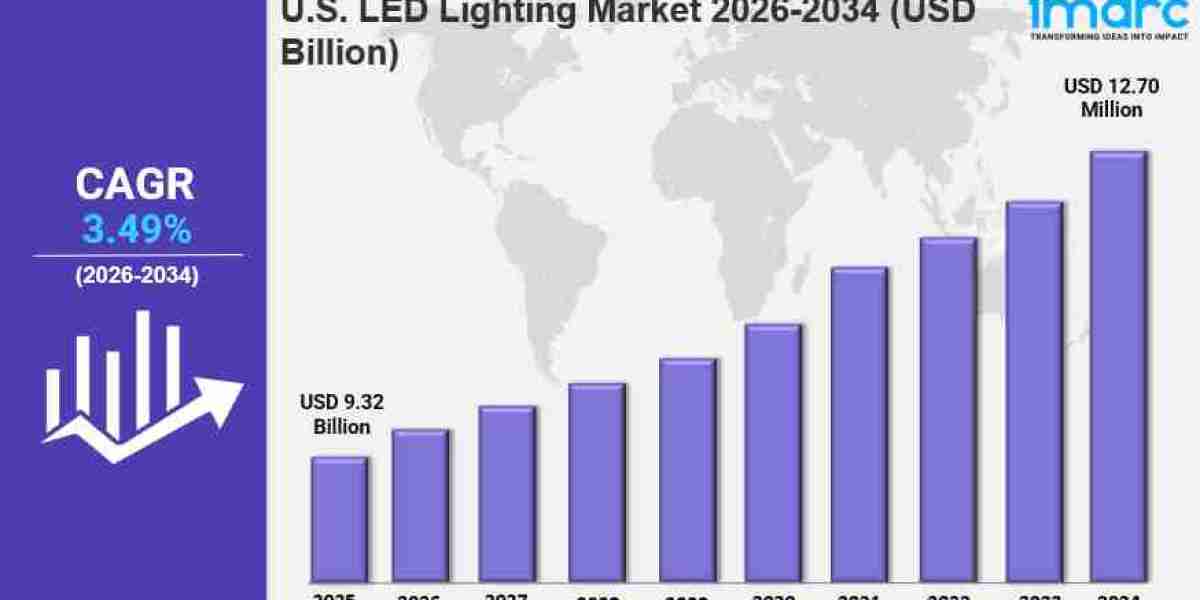

IMARC Group has recently released a new research study titled “U.S. LED Lighting Market Size, Share, Trends and Forecast by Application, and Region, 2026-2034”, offers a detailed analysis of the market drivers, segmentation, growth opportunities, trends and competitive landscape to understand the current and future market scenarios.
U.S. LED Lighting Market Size, Share, and Growth Forecast (2026–2034)
The U.S. LED lighting market size was valued at USD 9.32 billion in 2025 and is expected to reach USD 12.70 billion by 2034, growing at a CAGR of 3.49% during 2026–2034. Growth is supported by increasing emphasis on energy efficiency standards, ongoing advancements in smart lighting technologies, and widespread adoption across commercial, industrial, and residential applications
Key Market Statistics at a Glance
Base Year: 2025
Historical Years: 2020–2025
Forecast Period: 2026–2034
Market Size (2025): USD 9.32 Billion
Projected Size (2034): USD 12.70 Billion
Growth Rate: CAGR of 3.49%
Explore Growth Opportunities in the U.S. LED Lighting Market Grab Your Sample Report for Evaluation: https://www.imarcgroup.com/united-states-led-lighting-market/requestsample
U.S. LED Lighting Market Trends
In recent years, the U.S. LED lighting market has witnessed transformative trends that are reshaping consumer preferences and industry standards. One of the most notable trends is the increasing emphasis on smart lighting solutions, which integrate with home automation systems. By 2026, these smart LED products are expected to dominate the market, appealing to tech-savvy consumers seeking convenience and energy efficiency.
Furthermore, the market is seeing a shift towards human-centric lighting, focusing on the effects of light on well-being and productivity. This trend is driving innovations in color-tunable LED systems that adjust according to the time of day, enhancing the user experience.
Additionally, sustainability remains a key driver, with consumers increasingly demanding eco-friendly products. The U.S. LED lighting market growth is further supported by advancements in manufacturing technologies, which are lowering costs and improving product quality. As a result, the market is poised for substantial expansion, with a diverse array of products catering to various applications and consumer needs. Overall, these trends highlight a dynamic landscape that is evolving rapidly in response to technological advancements and changing consumer expectations.
U.S. LED Lighting Market Dynamics
Market Size and Growth Potential
The U.S. LED lighting market is experiencing significant growth, driven by increasing demand for energy-efficient lighting solutions. As of 2026, the market size is projected to reach approximately $20 billion, reflecting a compound annual growth rate (CAGR) of around 15% over the preceding years. This growth is largely attributed to the ongoing shift from traditional lighting technologies to LED alternatives, which offer longer lifespans and lower energy consumption. The push for sustainability and government incentives promoting energy efficiency are further enhancing market dynamics.
Moreover, the rise in smart home technologies and the Internet of Things (IoT) integration are expected to create new opportunities for LED manufacturers, thereby expanding the market landscape. As consumers and businesses alike become more environmentally conscious, the demand for LED lighting solutions is anticipated to escalate, making it a key player in the U.S. lighting industry.
Technological Advancements
Technological advancements are playing a pivotal role in shaping the U.S. LED lighting market. Innovations such as smart LEDs, which can be controlled via mobile applications, are gaining traction among consumers. By 2026, the integration of advanced features like dimming, color temperature adjustment, and energy monitoring will become commonplace, enhancing user experience and driving demand.
Additionally, improvements in manufacturing processes are leading to cost reductions, making LED products more accessible to a broader audience. The development of OLED (Organic LED) technology is also expected to contribute to market growth by offering flexible and thin lighting solutions for various applications. These technological advancements not only improve functionality but also align with the growing consumer preference for customizable and energy-efficient lighting options. As a result, the U.S. LED lighting market is set to witness a surge in innovation, further solidifying its position in the overall lighting sector.
Regulatory Environment and Sustainability Initiatives
The regulatory environment surrounding the U.S. LED lighting market is becoming increasingly stringent, with a focus on sustainability and energy efficiency. By 2026, federal and state regulations are expected to mandate higher energy performance standards for lighting products, which will significantly influence market dynamics. These regulations aim to reduce greenhouse gas emissions and promote the use of energy-efficient technologies.
Additionally, various sustainability initiatives are being implemented by both government and private sectors, encouraging the adoption of LED lighting solutions. Incentive programs, rebates, and tax credits for energy-efficient upgrades are boosting consumer interest and driving sales in the LED market. As awareness of environmental issues grows, consumers are more inclined to invest in sustainable products, further propelling the demand for LED lighting solutions. The combination of regulatory support and consumer demand for eco-friendly options is likely to create a robust framework for the growth of the U.S. LED lighting market.
U.S. LED Lighting Market Segmentation Analysis
By Application
Retrofit applications accounted for the largest share of the market, contributing 29.6% in 2025, equivalent to around USD 2.76 billion. This strong position is driven by the extensive installed base of legacy lighting systems, such as fluorescent and HID, across commercial buildings. In addition, energy benchmarking regulations in numerous U.S. cities are encouraging upgrades to more efficient lighting solutions.
Regional Market Insights
The Southern region led the market with a 31.4% share in 2025, supported by strong commercial construction activity and a significant presence of industrial facilities, particularly in Texas and along the Gulf Coast. Utility rebate programs are further accelerating LED adoption in the region. Texas remains a key contributor, accounting for over 12% of total U.S. LED lighting demand, driven by expanding commercial real estate and growing data center investments.
U.S. LED Lighting Market Key Competitive Landscape
key players
· Acuity Brands A leading provider of commercial and industrial LED lighting with strong capabilities in smart building integration and controls.
· Signify A global leader (formerly Philips Lighting) offering connected LED solutions and IoT-enabled lighting systems across sectors.
· Current Lighting Solutions Focuses on commercial and industrial LED solutions with integrated controls and sensor technologies.
· Leviton Manufacturing Co., Inc. Provides LED fixtures and advanced lighting controls with strong presence in retail and commercial applications.
· Lutron Electronics Specializes in premium lighting controls, dimming systems, and smart lighting solutions.
Speak to an Analyst: https://www.imarcgroup.com/request?type=report&id=20008&flag=C
Author IMARC Group
IMARC Group is a leading global management consulting firm providing comprehensive market research, feasibility studies, and strategic advisory services. The firm supports organizations worldwide in identifying growth opportunities, mitigating risks, and making informed business decisions across industries.
Contact Us
IMARC Group
Email: sales@imarcgroup.com
United States: +1-201-971-6302