
The Retail Lending Opportunity and Its Risks
Retail lending — the extension of credit to individual borrowers and small businesses for personal, consumption, and enterprise purposes — is the growth engine of the Indian NBFC sector. The potential market is vast: hundreds of millions of individuals and tens of millions of micro and small enterprises who need access to credit for purposes ranging from home improvement and vehicle purchase to working capital and equipment financing. For NBFCs positioned to serve these segments with speed, accessibility, and customer experience that traditional banks cannot match, the commercial opportunity is genuinely transformational.
But retail lending at scale is also the primary source of credit risk in the NBFC model. The diversity of the borrower population — spanning a wide range of income levels, employment types, creditworthiness profiles, and financial sophistication — means that managing portfolio quality requires both granular risk assessment at the individual borrower level and sophisticated portfolio analytics at the aggregate level. The volume of transactions involved makes purely manual approaches unviable, and the thin-file nature of many target borrowers limits the usefulness of conventional credit bureau data.
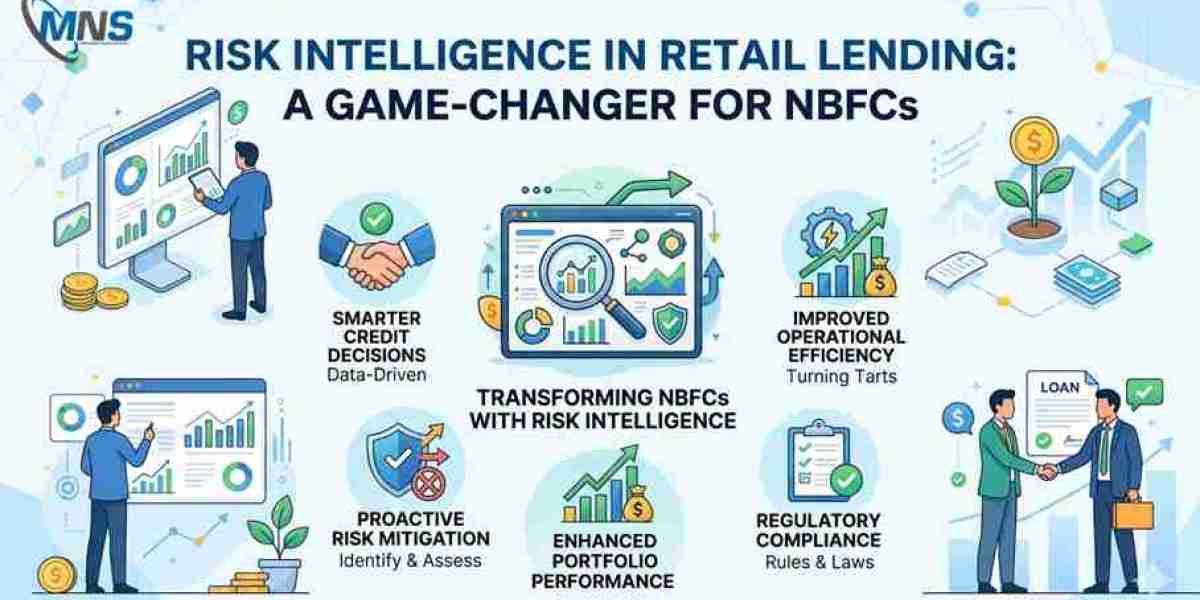
Risk intelligence is the game-changer that allows NBFCs to navigate this combination of opportunity and risk — making credit accessible to a broader population while maintaining the asset quality that sustainable lending requires.
The Thin-File Challenge and the Alternative Data Solution
The defining characteristic of retail NBFC lending — and its most significant risk intelligence challenge — is the thin-file problem. A large proportion of the target borrower population has limited or no formal credit history with mainstream credit bureaus. Traditional credit scoring models, trained primarily on bureau data, cannot generate reliable risk assessments for these borrowers, leaving NBFCs with a choice between excluding them from credit access or accepting them without adequate risk assessment.
Alternative data provides the solution. Bank transaction data, accessed through the Account Aggregator framework, reveals income patterns, expense behaviour, and financial resilience in a level of detail that no credit bureau file can match. GST filing histories provide evidence of business revenues and compliance behaviour for small enterprise borrowers. Utility and telecom payment patterns provide evidence of financial discipline for individuals without formal credit histories. And digital footprint data — app usage patterns, device characteristics, and digital transaction behaviour — provides supplementary behavioural signals that improve risk assessment accuracy for digitally active borrowers.
The integration of alternative data into retail credit scoring models, enabled by machine learning techniques that can extract meaningful signal from large, diverse datasets, has transformed the risk assessment accuracy available for thin-file borrowers — expanding the credit-accessible population without expanding the default rate.
Speed and Accuracy: The Dual Imperative
In retail lending, the competitive dynamics create a dual imperative that is difficult to satisfy through manual underwriting alone. Borrowers expect decisions in minutes, not days — particularly in digital lending channels where the entire application experience is framed around immediacy. At the same time, the volume and diversity of the borrower population makes inconsistent or inaccurate risk assessment at high speed commercially devastating — a fast decision that is systematically wrong on risk produces a portfolio that performs badly at scale.
Automated risk intelligence platforms address this dual imperative by applying sophisticated, multi-source risk assessments in seconds rather than days. A retail credit application can simultaneously trigger bureau checks, alternative data analysis, fraud detection screening, and Financial Ratios-based assessment of business income — generating a comprehensive risk score and a provisional credit decision in the time it takes a manual underwriter to open the file. The result is the combination of speed and accuracy that neither manual processing nor simple rule-based automation can deliver.
Portfolio Monitoring at Retail Scale
Managing a retail portfolio of tens of thousands or hundreds of thousands of accounts requires a fundamentally different monitoring approach from the relationship-based monitoring that works for small numbers of large commercial credits. Risk intelligence platforms that apply automated behavioural monitoring — tracking payment patterns, account activity, and external risk signals across the entire portfolio simultaneously — provide the scale of coverage that manual monitoring cannot achieve.
Early warning systems that flag individual accounts showing signs of stress — and aggregate these signals into portfolio-level heat maps that identify emerging concentrations of risk — give NBFC risk teams the visibility to intervene proactively across the full portfolio, not just in the accounts that have already crossed the attention threshold of individual relationship managers.
Fraud Intelligence in Retail Lending
Retail lending, by virtue of its scale and the relative anonymity of the borrower population, is disproportionately targeted by fraud — from first-party fraud involving misrepresentation of income and employment, to third-party identity fraud using stolen or synthetic identities, to organised ring fraud involving coordinated networks of fraudulent applications. Risk intelligence that incorporates fraud detection signals — device fingerprinting, behavioural biometrics, network analysis that identifies connections between applications, and real-time cross-referencing against known fraud databases — is essential for controlling the fraud losses that can materially distort retail portfolio performance.
Conclusion
Risk intelligence is not just an improvement to retail lending for NBFCs — it is the enabling infrastructure without which responsible retail lending at scale is not viable. The combination of alternative data, machine learning models, automated decisioning, real-time monitoring, and fraud intelligence creates a risk management capability that is qualitatively different from what was available even five years ago. NBFCs that invest in building or accessing this capability are positioning themselves to capture the enormous opportunity of India's retail credit market without the portfolio quality problems that have historically limited the sector's growth trajectory. In retail lending, intelligence is the difference between scaling successfully and scaling into crisis.